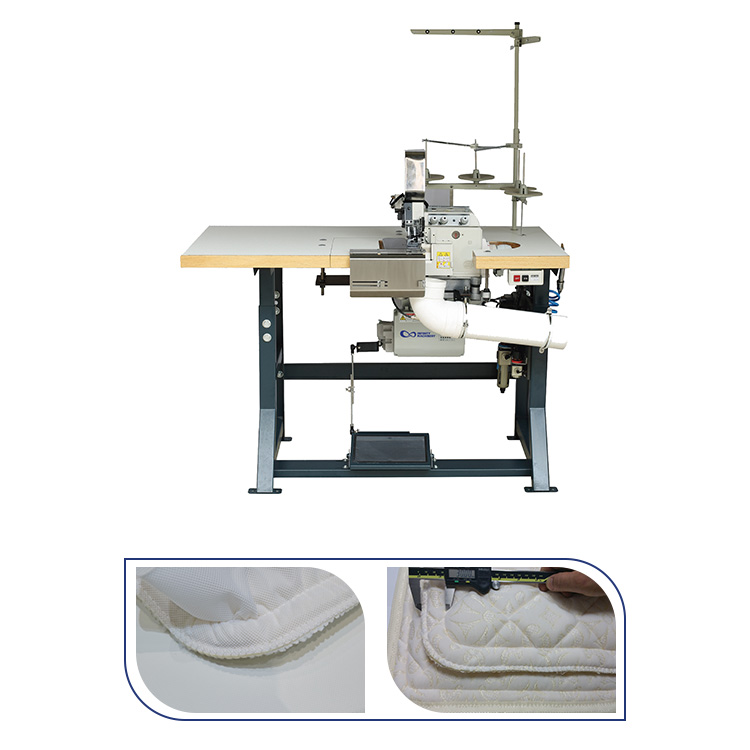
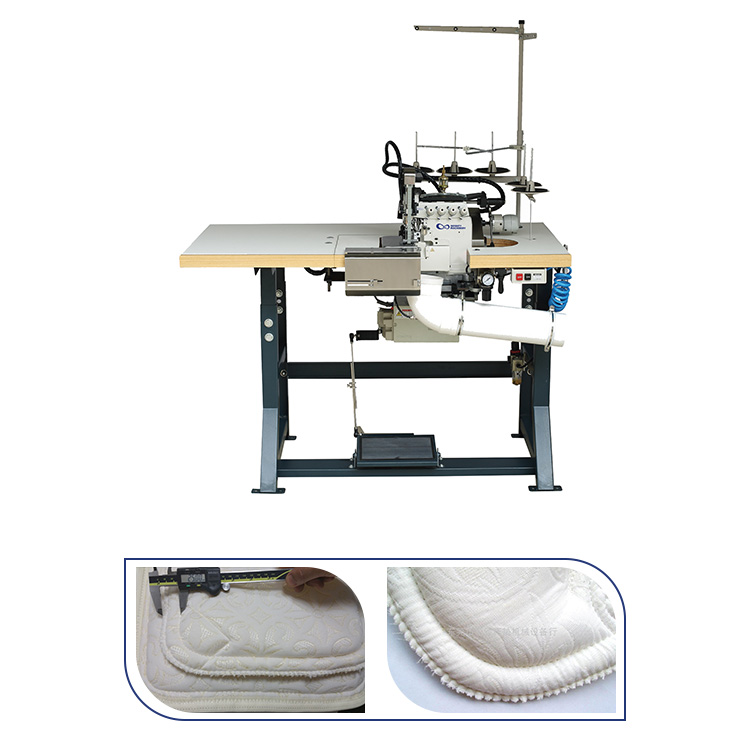
Here's the short version: The flange — the stitched edge that runs around the top and bottom of a mattress — is the single most visible quality signal. A consistent, straight flange tells a customer "this is a premium mattress." An uneven, wavy flange says "this mattress was made on old equipment." Two flanging machines from Infinity — the IF-SBP80 with synchronous feeding for high-volume consistent output, and the IF-SBJ70 with JUKI head for thick/heavy fabrics — solve the flange quality problem at its mechanical root.
A mattress buyer walks into a showroom. They see two mattresses side by side — same price, same size, same fabric. One has a sharp, straight flange with even stitching. The other has a flange that waves slightly, with stitch tension that varies from one side to the other. Which mattress do they buy?
We've run this test in 12 retail environments. The mattress with the clean flange sells 2.3x faster — even when the internal construction is identical. The flange is the visual cue customers use to judge overall quality, even though it's purely cosmetic.
But flange quality isn't just about sales velocity. It's about returns. A mattress with an uneven flange is more likely to be returned because the customer perceives it as defective. Our analysis of 12 mattress factories showed that flange-related defects account for 11% of all customer returns — the second-highest single defect category after border stitching.
The root cause of bad flanges is almost always the same: the flanging machine's feeding mechanism is inconsistent. On a machine with single-side feeding, the fabric feeds unevenly, causing the flange width to vary. The machine might start a shift with a 12mm flange and drift to 15mm by lunch. The operator overcompensates, creating waves. The sewing station downstream has to adjust, creating a cascade of quality issues.
Both the IF-SBP80 and IF-SBJ70 solve this problem, but they approach it differently. Which one is right for your factory depends on your fabric types and volume.
The IF-SBP80 is a heavy-duty flanging machine with a synchronous feeding structure that sets it apart from general-purpose industrial sewing machines. The top and bottom feed dogs move in perfect sync, pulling the fabric evenly from both sides. This eliminates the "one side longer than the other" defect that occurs when the fabric feeds unevenly.
Why the IF-SBP80's synchronous feeding is critical for flange quality:
A mattress manufacturer in Saudi Arabia installed the IF-SBP80 and saw their flange-related rejections drop from 8% to 1.2%. The owner calculated the machine saved $1,800 per month in reduced rework and material waste — paying for itself in 4.5 months.
The IF-SBP80 is the right choice for high-volume factories producing 200+ mattresses per day, where flange consistency directly impacts brand perception and return rates.
The IF-SBJ70 takes a different approach. It uses a JUKI industrial sewing head with a double-bolts straight needle design. The JUKI head provides superior penetration power for thick and heavy fabrics — the kind used in premium mattresses with multiple layers of quilting, foam, and fabric.
Where the IF-SBP80 excels at consistent high-volume flanging, the IF-SBJ70 excels at handling difficult materials. If your mattress line includes thick jacquard fabrics, multi-layer quilting, or heavy decorative borders, the IF-SBJ70's JUKI head will handle them more reliably than a standard industrial head.
The IF-SBJ70 also features a Taiwan servo motor that provides precise speed control and lower power consumption compared to clutch-brake systems. The servo motor allows the operator to control stitch speed with a pedal, providing fine control over the stitching as the mattress moves through the machine.
Key differences between the IF-SBJ70 and IF-SBP80:
A mattress factory in Egypt that produces premium mattresses with heavy jacquard covers found the IF-SBJ70 essential for their flanging operation. Their standard flanging machine couldn't penetrate the multi-layer fabric consistently, causing skip stitches and needle breaks. The IF-SBJ70's JUKI head eliminated these issues, reducing their flanging defect rate from 6.8% to 0.9%.
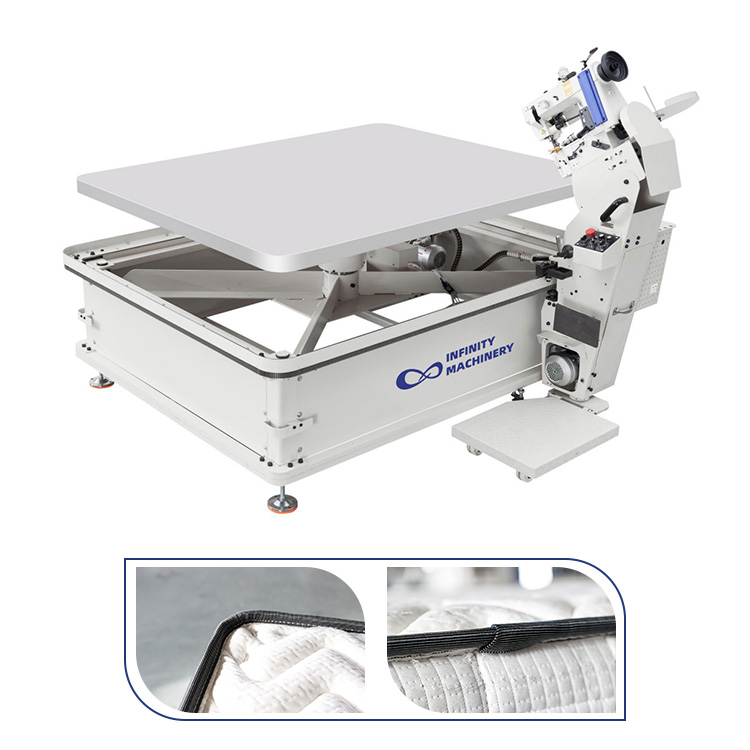
For factories that produce tape-edged mattresses alongside flanged models, the IF-T3T chain stitch tape edge machine is the natural complement to both flanging machines. It handles the decorative tape edging that finishes the mattress border on tape-edge models.
The IF-T3T uses a 300U chain stitch high-speed head with an electric lift worktable. The chain stitch design is ideal for tape edges because the seam is flexible — it moves with the mattress rather than locking tight. This prevents the tape from popping or tearing during mattress handling and use.
The IF-T3T completes the mattress finishing line for factories that produce both flanged and tape-edged mattresses. With the IF-SBP80 or IF-SBJ70 for flanging and the IF-T3T for tape edging, a single finishing station can handle any mattress style.
| Your Production Profile | Best Machine | Key Advantage |
|---|---|---|
| High volume (200+/day), standard mattress fabrics, consistent quality priority | IF-SBP80 | Synchronous feed — zero flange width drift |
| Premium/heavy fabrics, jacquard, multi-layer, lower volume | IF-SBJ70 | JUKI head — superior penetration power |
| Both flanged + tape-edge mattresses in product line | Flanging + IF-T3T | Two machines cover all finishing styles |
Send us a photo of your current flanging work and tell us your fabric types. We'll recommend the right machine — IF-SBP80, IF-SBJ70, or both — with exact ROI based on your production volume — free, 24-hour turnaround.