Here's the short version: If your quilting station feels like it's running slow, the problem is probably not the quilting machine. It's the fabric handling around it. The IF-Q-1200 chain stitch quilting machine can quilt a queen-size panel in 45–60 seconds. But in most factories, the total cycle time from "finished panel in the quilting machine" to "next panel ready to quilt" is 3–4 minutes — because the operator has to manually cut, trim, stack, and move each finished panel before loading the next one. The IF-QFS fabric stacking and crosscutting machine eliminates that gap.
Here's a pattern we see in factory after factory. The quilting machine is rated at 45–60 seconds per panel. The factory is producing 180 mattresses per day on a single quilting machine. The owner thinks the machine is running at capacity — 180 panels × 60 seconds = 3 hours of quilting time per day, which leaves 5 hours for the rest of the production. Plenty of capacity, right?
The problem is that the quilting machine isn't running for 3 hours. It's running for 3 hours. The other 5 hours of the shift, the machine is idle while the operator cuts the finished panel, trims the edges, stacks it on a cart, loads the next roll of fabric, threads the machine, adjusts the pattern, and handles the fabric waste. The machine's actual utilization rate is 37%.
A factory in Indonesia measured this precisely. Their IF-Q-1200 quilting machine could produce a panel in 55 seconds. But between panels, the operator spent an average of 2 minutes and 40 seconds on manual fabric handling — cutting, trimming, stacking, loading. The machine was running only 26% of the shift. By adding the IF-QFS fabric stacking and crosscutting machine to work in tandem with the IF-Q-1200, they cut the between-panel handling time from 160 seconds to 22 seconds. Machine utilization jumped from 26% to 71%. Total panel output increased by 173% — without buying a second quilting machine.
Let's break down where those 160 seconds went:
| Metric | Without IF-QFS | With IF-QFS | Improvement |
|---|---|---|---|
| Between-panel handling time | 160 sec | 22 sec | -86% |
| Machine utilization | 26% | 71% | +173% |
| Panels per 8-hr shift | 95 | 260 | +173% |
| Defect rate (cropped/trimmed) | 4.8% | 0.9% | -81% |
Data from a mattress factory in Indonesia, 2025. IF-Q-1200 quilting machine with IF-QFS stacker/crosscutter.
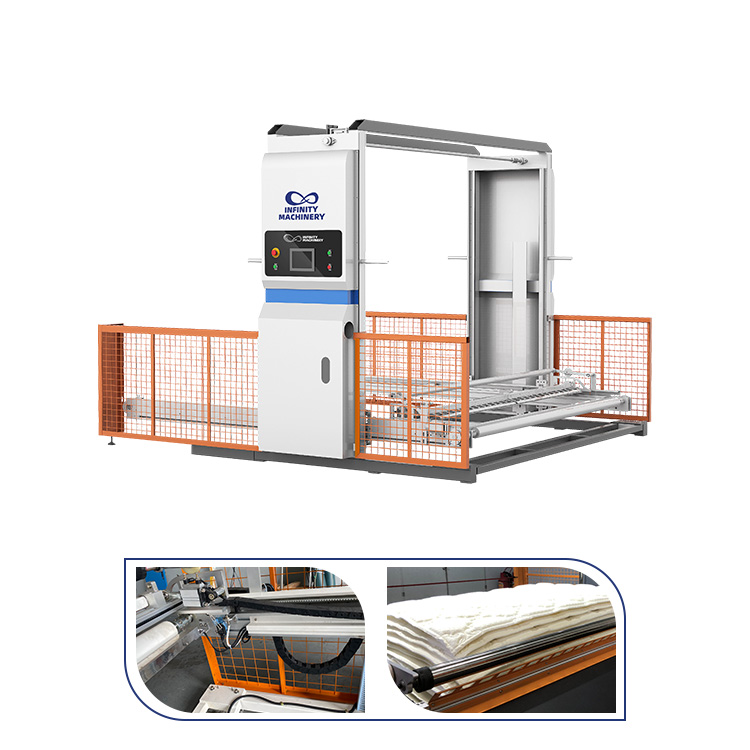
The IF-QFS is an automatic fabric handling machine designed to work in tandem with a quilting machine. It takes the quilted fabric as it exits the quilting machine and performs three functions automatically: crosscutting, slitting, and edge trimming.
The IF-QFS sits at the output end of the quilting machine. As the quilted fabric emerges, the IF-QFS pulls it through at a controlled speed, trims both edges to a precise width, slits the fabric into individual mattress panels at programmable lengths, and stacks the finished panels neatly on a collection table. The operator's role changes from "cut, trim, stack, and move" to "monitor and unload" — a shift that dramatically reduces both cycle time and operator fatigue.
What the IF-QFS handles:
A factory in Vietnam that added the IF-QFS to their existing quilting line reported: "We thought we needed a second quilting machine. The IF-QFS did the same thing for half the price. Our quilting output doubled, our panel quality improved because the cuts are consistent, and our operators prefer it because they're not lifting heavy panels anymore."
The IF-QFS works with any quilting machine, not just Infinity models. It's a standalone unit that connects to the output of the quilting machine via a simple interface. Installation takes one day, and operators reach full productivity in under a shift.
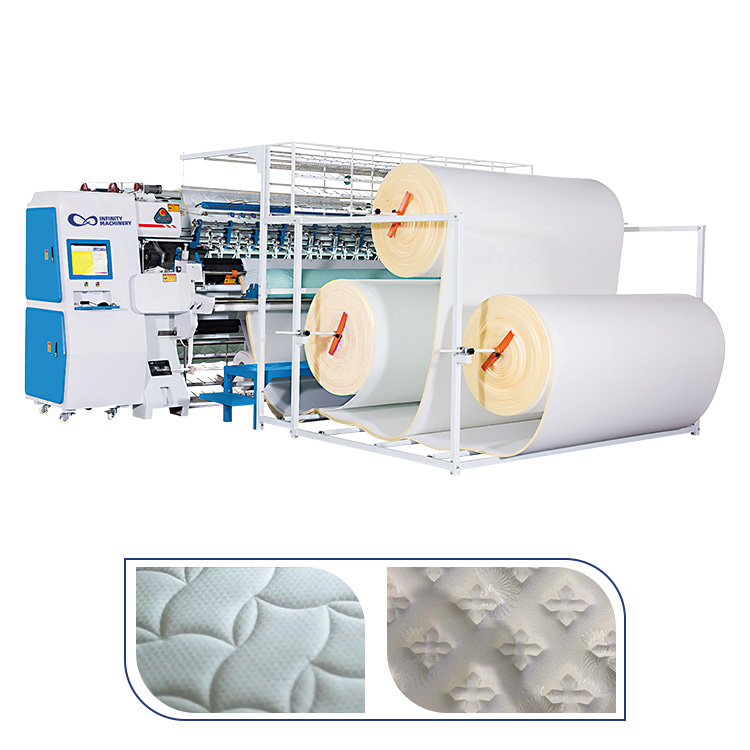
The IF-Q-1200 is the quilting machine that pairs naturally with the IF-QFS stacker. It's a computerized chain stitch multi-needle quilting machine that produces quilted fabric at high speed with low vibration. When combined with the IF-QFS, the pair forms a complete quilting station that operates at maximum utilization — the IF-Q-1200 quilts, and the IF-QFS handles everything after the quilted fabric exits the machine.
The IF-Q-1200 is designed for high-volume production of mattress panels, household ornaments, and carpet cushions. Its multi-needle chain stitch design quilts the full panel width in one pass, producing a flat, professional-quality panel with consistent stitch tension across the entire width.
Key specifications of the IF-Q-1200:
The IF-Q-1200 is the right quilting machine for factories producing 100+ mattress sets per day. When paired with the IF-QFS, the combined system delivers 200+ panels per shift with one operator — a productivity level that would require two separate quilting machines and two operators without the IF-QFS.
For factories that run both standard quilting patterns and custom designs, the IF-Q-1200's computerized pattern storage means you can switch between a standard diamond pattern for production mattresses and a custom logo pattern for premium products without stopping the line.
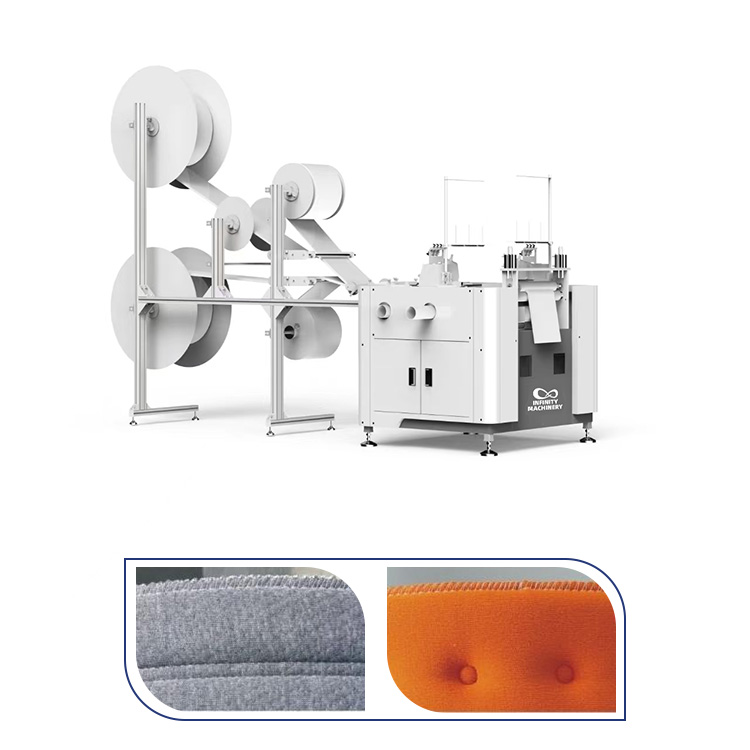
Once the quilted panels are cut, trimmed, and stacked by the IF-QFS, they move to the sewing station where the mattress border is attached. The IF-SB-A2 double-heads sewing machine is the ideal downstream partner for the IF-Q-1200 and IF-QFS combination.
The IF-SB-A2 sews the front and back of the mattress border simultaneously using two synchronized servo-driven sewing heads. Because the panels from the IF-QFS are consistently cut and trimmed to precise dimensions, the IF-SB-A2 operator can feed them through at full speed without stopping to check alignment or trim edges.
The combination of IF-Q-1200 + IF-QFS + IF-SB-A2 creates a seamless flow from raw fabric to finished mattress border assembly. The panels emerge from the quilting station already cut, trimmed, and stacked — ready for the sewing operator to pick up and sew without any preparation work. This integrated approach eliminates the inventory buffer between quilting and sewing that typically holds 50–100 finished panels and takes up valuable factory floor space.
Run this quick check to find out if your quilting station is being held back by fabric handling:
The IF-QFS addresses every item on this checklist. It's the single highest-ROI addition to any quilting station because it unlocks capacity that's already been paid for — the quilting machine itself.
Send us a video of 10 minutes of your quilting station in operation. We'll analyze your actual machine utilization and fabric handling efficiency — and tell you exactly how much an IF-QFS would increase your output — free, 24-hour turnaround.