Here's a question that comes up in every factory we visit: should I use lock stitch or chain stitch for quilting my mattress panels? It sounds like a technical detail, but the answer affects thread consumption, production speed, panel durability, and even your return rate. The two stitch types are not interchangeable — each has a specific job it does best. And the best-run factories don't choose one. They have both machines on the floor and use each for the right application. This guide compares the IF-QM1-4 (lock stitch) and the IF-Q-1200 (chain stitch) so you can decide which to buy — or whether to buy both.
Before we compare machines, let's understand the two stitch types — because the stitch is what determines the machine you need.
Lock stitch uses two threads — a needle thread and a bobbin thread — that interlock inside the fabric layers. The interlock creates a strong, secure seam that won't unravel even if a thread is cut. Lock stitch is the standard for premium mattresses because it holds up to years of use without coming apart. The trade-off is speed: lock stitch machines are typically slower because each stitch requires the needle to pass through the fabric, the bobbin hook to catch the thread, and the take-up lever to tighten the stitch.
Chain stitch uses one or more needle threads that form a series of interlocking loops on the underside of the fabric. Chain stitch is faster than lock stitch — the loop formation requires less mechanical motion per stitch — and uses less thread overall. The trade-off is security: if a chain stitch is cut or broken, the entire seam can unravel because each loop relies on the previous one. However, for many mattress applications where the quilted panel is inside a mattress cover and not under direct stress, chain stitch is perfectly adequate.
| Factor | Lock Stitch (IF-QM1-4) | Chain Stitch (IF-Q-1200) |
|---|---|---|
| Seam security | Excellent — will not unravel | Good — unravels if cut |
| Production speed | 8–12 m/min | 12–15 m/min |
| Thread consumption | Higher (bobbin thread) | Lower (no bobbin) |
| Embroidery patterns | Complex patterns possible | Simple patterns best |
| Best for | Premium/exposed panels | High-volume/covered panels |
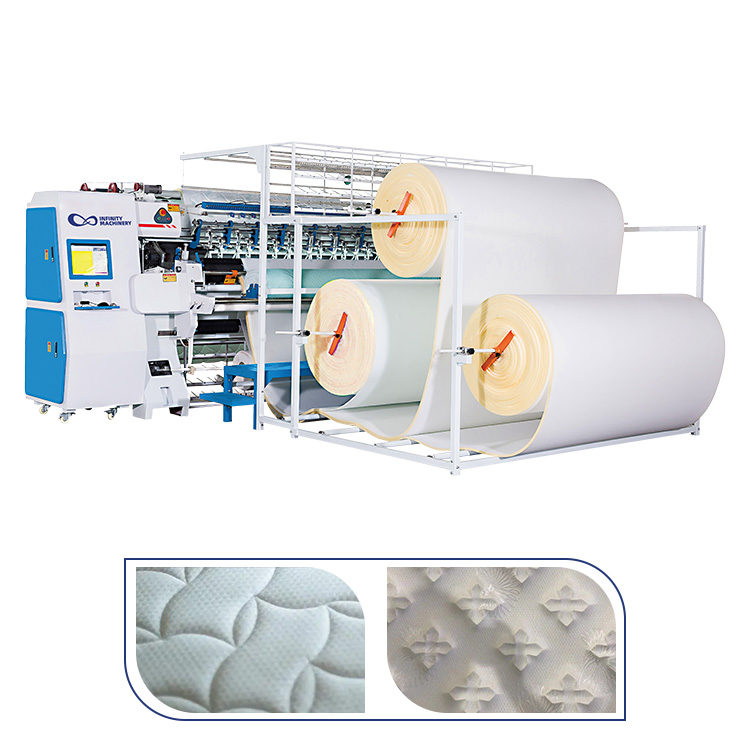
The IF-QM1-4 Automatic Lock Stitch Quilting Machine is our multi-needle lock stitch quilting solution. It's designed for factories that produce premium mattresses where the quilted panel is visible and the customer can see — and feel — the stitch quality. Lock stitch quilting creates a seam that is identical on both sides of the fabric, giving a clean, finished appearance that signals quality to the end customer.
The IF-QM1-4 is available in three quilting widths — 64 inches, 96 inches, and 128 inches — covering everything from single mattress panels to king-size and custom sizes. Its computer-controlled multi-needle head can quilt complex geometric patterns, diamond patterns, and custom embroidery designs, all stored digitally and recalled instantly through the touchscreen interface.
Here's where the IF-QM1-4 really shines: lock stitch quilting is the preferred stitch type for mattress panels that will be visible on the finished product — pillow-top covers, euro-top borders, and decorative panel surfaces. Because lock stitch doesn't unravel, these panels can be cut, sewn, and handled without worrying about the stitches pulling out at the edges. A factory in Vietnam that switched from chain stitch to lock stitch for their premium line saw their panel-related returns drop from 3.2% to 0.4% — customers were no longer returning mattresses because of loose threads or unraveling seams at the panel edges.
Key features of the IF-QM1-4:
The IF-Q-1200 Computerized Chain Stitch Multi-Functional Quilting Machine takes a different approach. It uses a multi-needle chain stitch head that runs at speeds up to 15 m/min — significantly faster than lock stitch for equivalent patterns. The chain stitch uses less thread per meter of quilting (no bobbin thread), reducing consumable costs by approximately 30% compared to lock stitch.
The IF-Q-1200 is designed for high-volume production of mattress panels where the quilted surface will be covered — for example, the internal quilted layer in a mattress that has a separate outer cover, or the backing layer that sits against the spring unit. In these applications, the stitch is not visible to the end customer, so the superior seam security of lock stitch is not needed, and the speed and cost advantages of chain stitch make it the better choice.
Where the IF-Q-1200 excels is in production throughput. A factory running two shifts on the IF-Q-1200 can produce 35–40% more quilted panels per day than an equivalent lock stitch machine — the same number of operators, the same floor space, but significantly more output. For factories that supply hotels, hospitals, or budget mattress lines where volume matters more than visible stitch quality, the IF-Q-1200 is often the more profitable choice.
Key features of the IF-Q-1200:
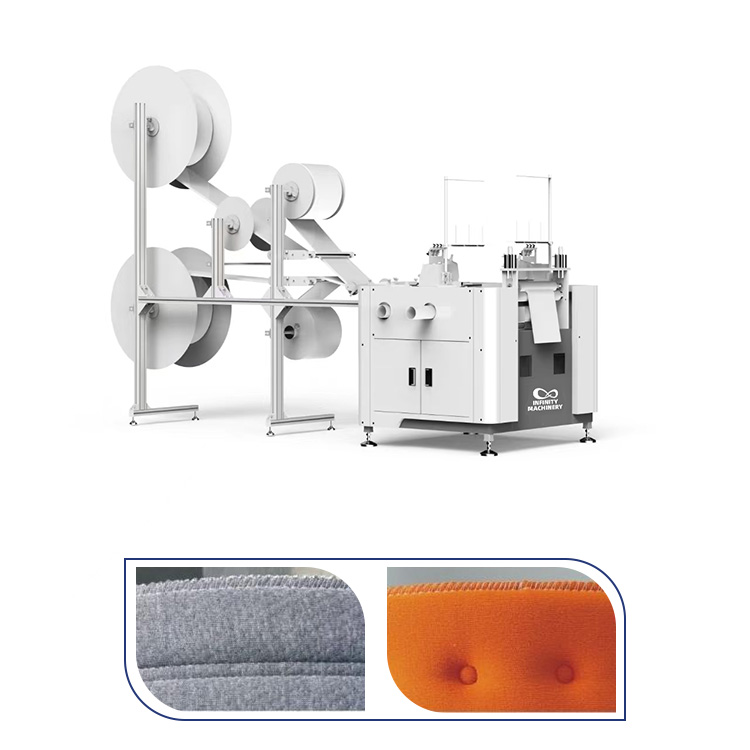
Once your panels are quilted — whether with lock stitch or chain stitch — the next step is sewing them into finished mattress panels. The IF-SB-A2 Front and Back Double-heads Mattress Sewing Machine is the ideal complement to both the IF-QM1-4 and the IF-Q-1200, completing the panel production line from raw fabric to finished panel.
The IF-SB-A2's dual-head design sews both the front and back panels simultaneously, ensuring that your panel sewing capacity keeps pace with your quilting output — whether you're running a single quilting machine or a bank of several. With its servo motor, adjustable fabric expander, and automatic rolling mechanism, it handles the transition from quilted fabric to assembled panel in one smooth operation.
Many of the factories we work with start with one quilting machine — either the IF-QM1-4 for premium lines or the IF-Q-1200 for high volume — and add the second type within 6–12 months as they expand their product range. The IF-SB-A2 sewing machine is the common thread that ties both lines together, handling the panel assembly regardless of which quilting machine produced the fabric.
Here's how we guide factories through this decision based on their product mix and volume:
If you manufacture premium mattresses with visible quilted panels: Start with the IF-QM1-4 lock stitch machine. Your customers can see and feel the panel surface — loose threads or unraveling seams are not acceptable at this price point. The IF-QM1-4's lock stitch ensures that the panel surface stays intact for the life of the mattress, and the ability to quilt complex patterns gives your product a distinctive look that justifies a higher selling price.
If you manufacture high-volume mattresses for contract or budget markets: Start with the IF-Q-1200 chain stitch machine. Speed and thread cost matter more than visible stitch quality. The IF-Q-1200 will produce 35–40% more panels per shift than a lock stitch machine, and the chain stitch is perfectly adequate for panels that will be covered by a mattress outer fabric.
If you manufacture both premium and volume lines: Buy both machines. This is the most common pattern we see among successful factories. The IF-QM1-4 handles the premium line where stitch quality matters; the IF-Q-1200 handles the volume line where speed matters. The two machines share the same floor space and often the same operator, and having both gives you the flexibility to shift production between lines as demand changes.
A factory in Egypt that followed this dual-machine approach told us: "We bought the IF-Q-1200 first for our hotel mattress line. After six months, our retail customers started asking for a higher-end product with better visible quilting. We added the IF-QM1-4 for the premium line. Now we run both machines in parallel — the Q-1200 for contract work and the QM1-4 for retail. The panel sewing machine ties both lines together. It's the best setup we've ever had."
| Your Situation | Start With | Add Later | Panel Line |
|---|---|---|---|
| Premium mattresses, visible panels | IF-QM1-4 | IF-Q-1200 | IF-SB-A2 |
| High volume, contract/budget | IF-Q-1200 | IF-QM1-4 | IF-SB-A2 |
| Both premium + volume lines | Both | — | IF-SB-A2 |
The IF-SB-A2 sewing machine is the common element in every configuration. It handles panel assembly regardless of which quilting machine produced the fabric.
The IF-QM1-4 and IF-Q-1200 are not competing machines. They're complementary tools for different market segments. The factories that grow fastest are the ones that recognize this early and invest in both — giving them the flexibility to serve premium and volume markets simultaneously with the right equipment for each.
And whichever machine you choose, the IF-SB-A2 sewing machine ensures that your investment in quilting translates directly into finished panels — completing the production line and maximizing the return on your quilting equipment.
Send us your product mix — premium line volumes, budget line volumes, panel types, and target markets. We'll recommend the exact machine configuration that minimizes your cost and maximizes your quality — free, no obligation, usually within 24 hours.