Here's a question most foam factory owners don't ask: how flat are your cut slabs? A slab that's off by 2mm at the center might not look like a problem — until you try to bond it to another slab and the gap shows up as a weak line. Or until your customer measures the thickness and finds it varies by 3mm from one end to the other. Horizontal foam cutting is the most common cutting operation in any foam factory, but the difference between a cut that's "good enough" and one that's consistently flat across 2 meters of foam is the difference between a machine that guides the blade on both ends and one that doesn't. This guide compares two approaches to horizontal cutting — long track and standard — so you can choose the right one for your slab quality requirements.
Horizontal foam cutting sounds simple: feed a block through a horizontal blade, and it comes out as slabs of equal thickness. But here's what happens in practice. On a standard horizontal cutter, the blade is guided by a roller or track on one side only. The opposite side of the blade — the side that's cutting through the middle of a 2-meter-wide block — has no direct guidance. As the blade heats up from friction and the foam density varies across the block width, the unguided side of the blade drifts. The result is a slab that's thicker on one side than the other — sometimes by 2–3mm across a 2-meter width.
A factory in Thailand was producing foam slabs with an average thickness variation of 2.8mm across the width of their 2m blocks. They didn't notice because they measured slab thickness at one edge only — the standard practice in many factories. When they switched to a customer who required ±1mm tolerance across the full width, they failed inspection on 23% of their slabs. That's 23% waste on their highest-volume product line. At $3,200 per ton for polyurethane foam, with a monthly output of 25 tons, the waste was costing them $18,400 per month in material alone.
The fix was upgrading to a long-track horizontal cutter that guides the blade on both ends. Slab thickness variation dropped from 2.8mm to 0.5mm. The 23% rejection rate went to zero. The machine paid for itself in 3 months.
The point of this story isn't that every factory needs a long-track cutter. It's that the quality of your horizontal cutting directly affects your bottom line — and most factory owners don't measure it.
| Feature | IF-FPQ1 Standard | IF-LT1650 Long Track |
|---|---|---|
| Blade guidance | Single side | Both ends (long track) |
| Slab thickness accuracy | ±1.5–2mm | ±0.5mm |
| Max block width | 2,150mm | 2,450mm |
| Cutting speed | Up to 5 m/min | Up to 5 m/min |
| Cutting thickness range | 2–150mm | 2–150mm |
| Best for | Standard slab cutting | High-precision/tolerance |
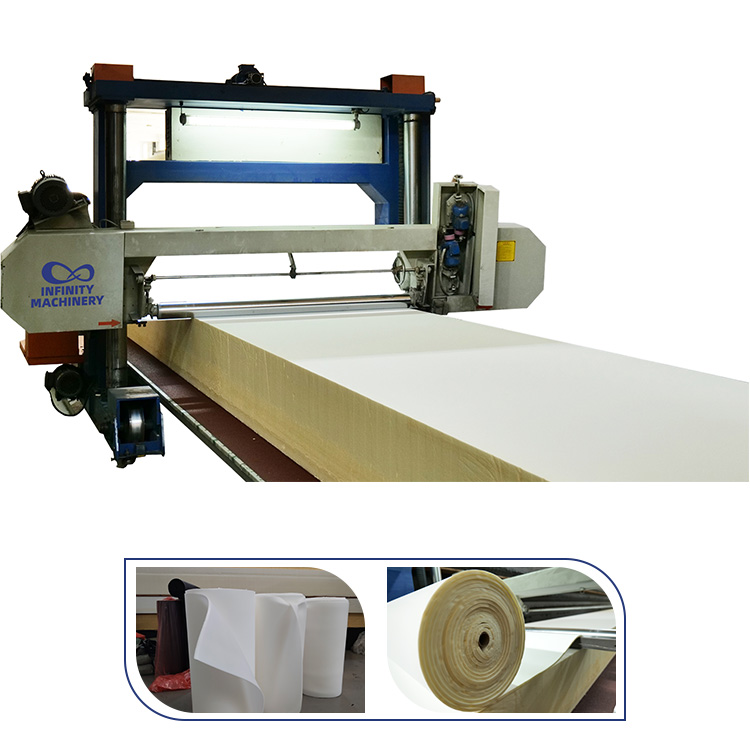
The IF-LT1650/2450 Horizontal Long Track Foam Cutting Machine is designed for one purpose: cutting foam slabs with the highest possible thickness accuracy across the full width of the block. Its distinguishing feature is the long track that guides the blade carriage on both ends — not just one side, but both. This dual-guidance system keeps the blade parallel to the cutting bed at all times, preventing the blade drift that causes uneven slab thickness.
The IF-LT1650 has a cutting width of 1,650mm, and the IF-LT2450 handles blocks up to 2,450mm wide. Both models use a horizontal band blade driven by a variable-speed motor that adjusts automatically to foam density — cutting softer foam at higher speeds and denser foam at slower speeds to maintain clean cut surfaces without tearing.
Key features that deliver precision cutting:
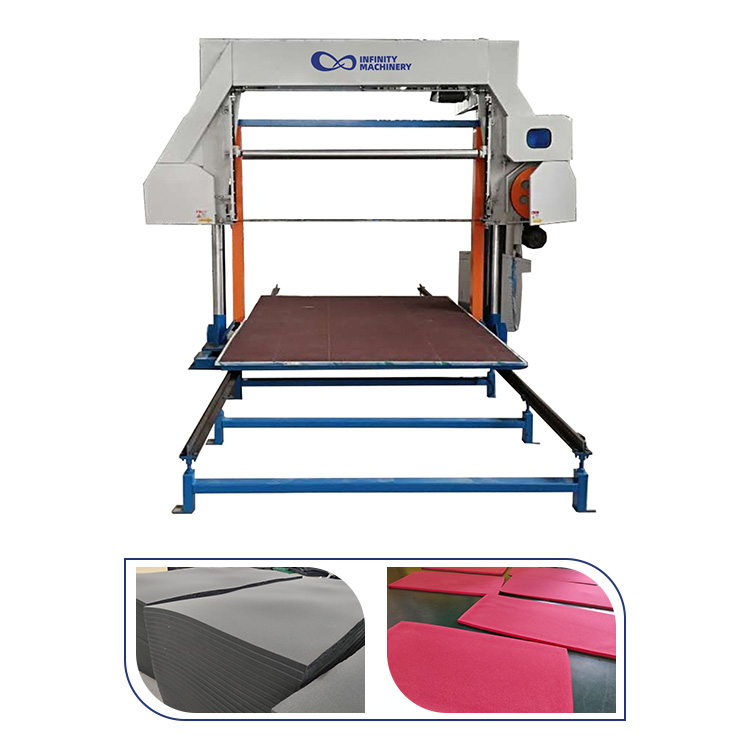
The IF-FPQ1-1650/2150 Horizontal Foam Cutting Machine is the workhorse of foam slab production. It's a simpler, more affordable machine than the long-track model, designed for factories that cut standard foam slabs where ±1.5–2mm thickness variation across the block width is acceptable.
The IF-FPQ1 uses a digital control system with a touch-screen PLC. The operator sets the desired slab thickness on the panel, and the machine automatically positions the blade and feeds the foam block through at a consistent speed. The worktable reciprocates automatically, allowing continuous cutting without manual repositioning.
What factory owners appreciate most about the IF-FPQ1 is its reliability. There's very little to go wrong: a motor, a blade, a roller system, and a control box. Maintenance consists of blade changes (every 4–6 weeks depending on volume) and occasional lubrication of the guide rails. The touch-screen interface makes it easy to train new operators — most reach full productivity within one shift.
The IF-FPQ1 is available in two widths: 1,650mm and 2,150mm. Both models share the same control system and cutting mechanism — the only difference is the width capacity. For factories that produce standard foam products where ±2mm thickness tolerance is acceptable, the IF-FPQ1 offers the best value of any horizontal cutter in its class.
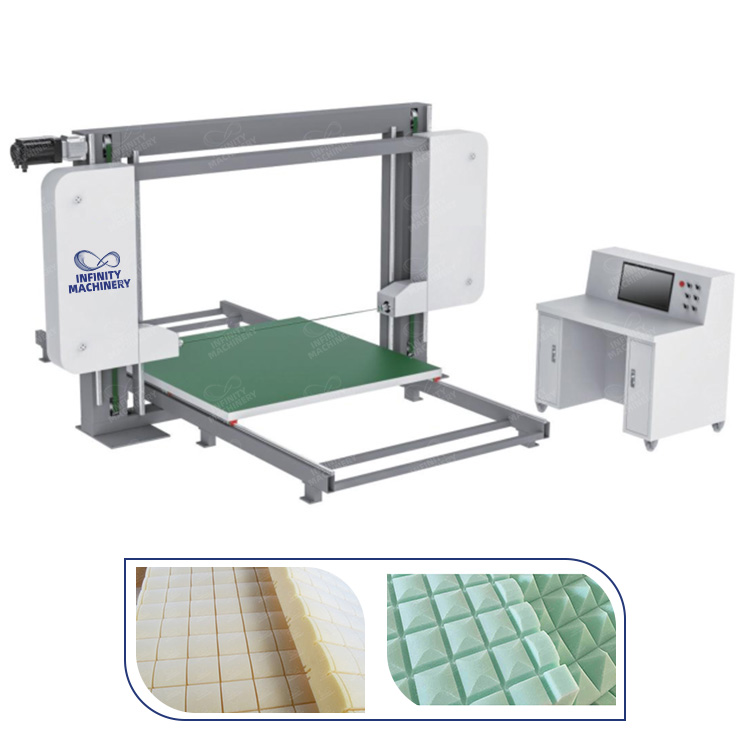
For factories that cut foam into both slabs and shaped products, the IF-CNCH Horizontal Blade CNC Foam Cutting Machine combines horizontal cutting capability with full CNC shape cutting — one machine that can both slice blocks into slabs and cut slabs into finished shapes. It's the recommended upgrade path for factories that start with a standard horizontal cutter and grow into needing precision shaping.
With the IF-CNCH, you can import CAD files for 2D shapes and the machine cuts them automatically from pre-sliced slabs. With X, Y, and C axis control, the horizontal blade handles both straight slab cutting and contour cutting in one setup — eliminating the need to move material between machines. Most factories add the IF-CNCH when their standard horizontal cutter reaches capacity and they want to move into CNC precision without adding a dedicated shape cutting line.
Here's a simple way to decide based on your slab quality requirements:
If your customers accept ±2mm thickness variation across the slab width — typical for mattress core foam, packaging foam, and general-purpose polyurethane — the IF-FPQ1 standard cutter is your best value. It's affordable, reliable, and produces good-quality slabs for most applications.
If your customers require ±1mm or better — typical for technical foam, acoustic panels, filter foam, or high-end mattress components — the IF-LT1650/2450 long-track cutter is the right choice. Its dual-guidance system delivers consistent thickness accuracy across the full block width.
If you're cutting both slabs and shaped products — the IF-CNCH gives you both capabilities in one machine. It's the most versatile option and the best long-term investment for factories that produce a mix of slab and contour-cut products.
The factory in Thailand that we mentioned earlier chose the IF-LT1650 for their precision line. But they kept their existing IF-FPQ1 for standard production — using the long-track machine only for customers who required tight tolerances, and the standard machine for everything else. That dual-machine approach is common among factories that produce for both precision and general-purpose markets.
| Your Requirement | Best Choice | Accuracy | Investment Level |
|---|---|---|---|
| Standard slab cutting, ±2mm OK | IF-FPQ1 | ±1.5–2mm | $ |
| Precision slabs, ±1mm required | IF-LT1650/2450 | ±0.5mm | $$ |
| Slabs + shaped products, max flexibility | IF-CNCH | ±0.5mm + CNC | $$$ |
The IF-FPQ1, IF-LT1650, and IF-CNCH represent three levels of horizontal cutting capability. Each has its place in a well-equipped foam cutting room. The right choice depends on your customers' tolerance requirements — and whether you're measuring your slab thickness across the full width, or just at one edge.
Because the 2mm that disappears at the far edge of your slab isn't gone — it's coming out of your bottom line.
Send us your slab thickness tolerance requirements, block sizes, and monthly volume. We'll recommend the exact machine configuration — free, no obligation, usually within 24 hours.