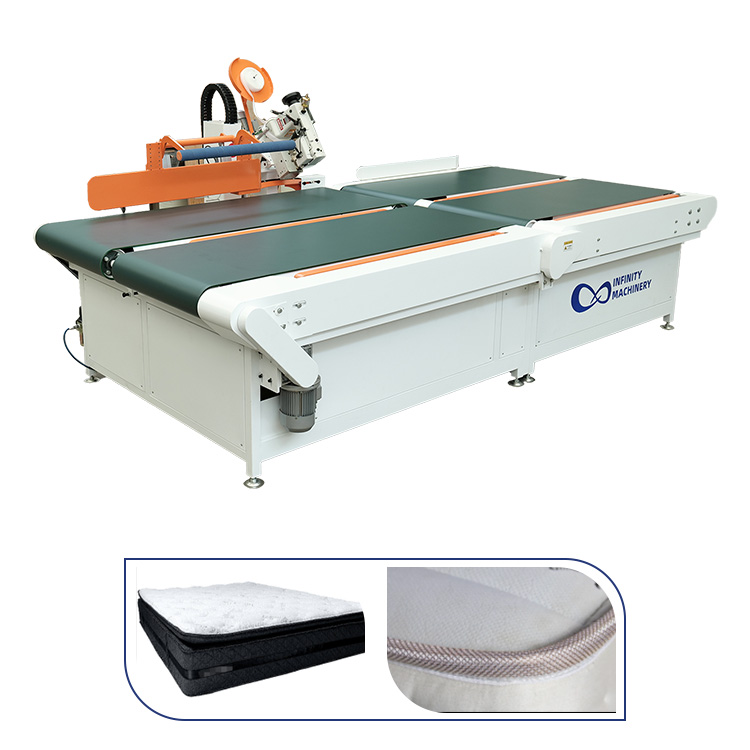
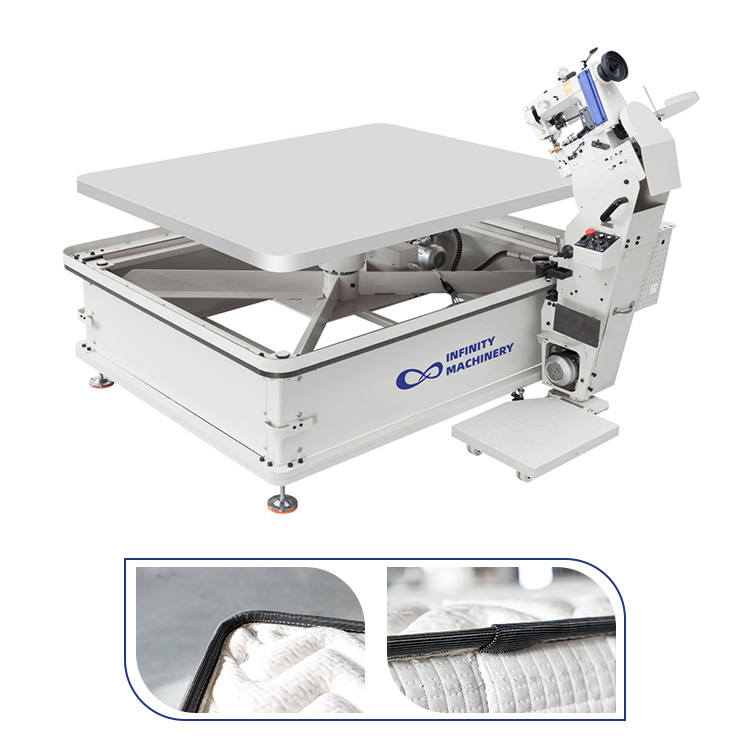
Here's a question we ask every factory owner we work with: how many mattresses do you tape edge per shift, and how many operators does it take? The answer tells us immediately whether they're overpaying for labor or leaving capacity on the table. A tape edge machine is one of the longest-lasting investments in a mattress factory — 10 to 15 years is normal. Choosing the wrong level of automation — semi-auto when you need full-auto, or full-auto when semi-auto would do — costs $8,000 to $16,000 per year in either excess labor or underutilized equipment. This guide breaks down the decision so you get it right the first time.
The tape edge machine is the last piece of equipment on a mattress production line before the finished product goes to packing. It applies the decorative border tape that covers the raw edge of the mattress, providing both a finished appearance and structural reinforcement. It's a simple operation — feed the mattress, guide the tape, let the machine sew it on — but the economics of how you do it vary dramatically depending on your volume and labor costs.
Before we compare machines, let's look at the two options:
Semi-automatic (IF-T2): The operator guides the mattress through the machine and controls the tape feed manually. Lower upfront cost ($3,500–$5,500). Requires one dedicated operator per shift. Output of 10–15 mattresses per hour depending on mattress size and operator experience. Best for factories producing 30,000 to 80,000 mattresses per year.
Fully automatic (IF-T4): The machine feeds the mattress automatically through the sewing head. The operator loads the mattress and unloads it at the other end. Higher upfront cost ($8,000–$14,000). One operator can manage two machines simultaneously. Output of 20–30 mattresses per hour per machine. Best for factories producing 80,000+ mattresses per year.
The key insight that most factory owners miss: the break-even point between semi-auto and full-auto is not where you think it is. Because one operator can run two IF-T4 machines, the labor cost per mattress drops dramatically at higher volumes. A factory producing 100,000 mattresses per year with two IF-T4 machines and one operator per shift will have a lower cost per mattress than a factory with one IF-T4 and one operator — even though the equipment cost is higher.
| Scenario | 50K/yr (Semi-Auto) | 50K/yr (Full-Auto) | 100K/yr (2× Full-Auto) |
|---|---|---|---|
| Equipment cost (amortized 10yr) | $450 | $1,100 | $2,200 |
| Operator labor (2 shifts) | $28,000 | $28,000 | $28,000 |
| Total annual cost | $28,450 | $29,100 | $30,200 |
| Cost per mattress | $0.57 | $0.58 | $0.30 |
Assumes $14/hr labor rate, 2,000 hours per shift per year. Full-auto at 50K/yr uses one machine with one operator (underutilized). Two full-auto machines at 100K/yr share one operator per shift, halving the labor cost per mattress.
The IF-T2 Semi-auto High Speed Mattress Tape Edge Machine is our entry-level tape edge machine, but "entry-level" doesn't mean low quality. It uses an advanced chain stitch or lock stitch sewing head — the same heads found on machines costing twice as much — and is built on a sturdy frame designed for continuous shift operation.
The IF-T2 is semi-automatic, meaning the operator guides the mattress through the machine manually. This gives the operator full control over the stitching process — useful for factories that produce a wide variety of mattress sizes and need to adjust the stitching on the fly. The operator can slow down at corners, speed up on straight sections, and visually inspect the tape alignment as the mattress feeds through.
What factory owners consistently tell us they appreciate about the IF-T2 is its simplicity. There's no complex computer system to learn, no sensors to calibrate, no automatic feed mechanisms to maintain. A new operator can be trained to produce acceptable output in a single shift and reach full speed within a week. For factories with high operator turnover — common in the mattress industry — this short learning curve has real economic value.
Key features of the IF-T2:
The IF-T4 Automatic High Speed Mattress Tape Edge Machine takes the same sewing technology as the IF-T2 and adds fully automatic mattress feeding. Instead of the operator guiding the mattress through the machine, the IF-T4 uses powered rollers and a synchronized feed system that pulls the mattress through at a consistent speed — eliminating the variability that comes with manual feeding.
The operator's job changes from active guiding to loading and unloading. Place the mattress on the input table, press the start button, walk to the output end, and remove the finished mattress. That's it. The machine handles the stitching, tape feeding, and mattress transport automatically.
This change may sound small, but it has three significant economic effects:
The IF-T4 is particularly well-suited for factories that produce long runs of the same mattress size — a common pattern in contract mattress manufacturing for hotels, hospitals, and dormitories. With the automatic feed handling the repetitive work, the operator's role shifts to quality inspection, catching tape alignment issues or stitch defects as the mattress exits the machine.
Not every factory fits neatly into the semi-auto or full-auto category. For factories producing 50,000 to 80,000 mattresses per year — the range where semi-auto is stretched to its limit but full-auto hasn't quite paid for itself — the IF-T3T Chain Stitch High Speed Mattress Tape Edge Machine hits a sweet spot.
The IF-T3T uses the same advanced 300U chain stitch high-speed sewing head as the IF-T4, combined with an electric lift work table and a manually adjustable sewing head similar to the IF-T2. It's semi-automatic in operation — the operator guides the mattress — but its chain stitch head runs at higher speeds than the IF-T2's standard head, allowing experienced operators to reach 18–22 mattresses per hour.
For factories that expect to grow, the IF-T3T is often the smartest choice. It's affordable enough that it doesn't strain the budget at current volumes, but its higher-speed sewing head means it won't become the bottleneck when production grows. Many factories start with the IF-T3T and add an IF-T4 as their volume increases, running both machines in parallel with one operator — the IF-T4 for standard sizes and the IF-T3T for custom orders or backup capacity.
Based on our experience working with hundreds of mattress factories, here's a straightforward way to decide which tape edge machine is right for your current situation:
A factory in Kenya that we worked with was running two IF-T2 machines at 70,000 mattresses per year with two operators per shift. They were right at the edge of the IF-T2's comfortable range. We recommended they replace one IF-T2 with an IF-T4, keeping the second IF-T2 for custom sizes. The result: one operator per shift ran both machines (T4 for standard sizes, T2 for custom orders). Output increased by 35%, labor cost dropped by 40%, and the equipment payback was 9 months.
The tape edge machine is one of the longest-lasting investments in your factory — 10 to 15 years of daily use is normal. Choosing the right level of automation today will save you thousands every year for the entire life of the machine. And if you choose the IF-T4 with future growth in mind, the economics only get better as your volume increases.
| Your Volume | Recommended Machine | Cost per Mattress | Payback vs Next Level |
|---|---|---|---|
| < 30K/yr | IF-T2 | $0.75–$0.90 | N/A |
| 30K–80K/yr | IF-T3T or IF-T2×2 | $0.55–$0.70 | 18–24 mo |
| 80K–150K/yr | IF-T4 × 1 | $0.42–$0.55 | 12–18 mo |
| 150K+/yr | IF-T4 × 2 | $0.28–$0.35 | 6–9 mo |
Based on $14/hr labor rate, 2 shifts/day, 250 days/year. Equipment amortized over 10 years.
The IF-T2, IF-T3T, and IF-T4 aren't competing machines. They're different tools for different scales of production. Choosing the right one for your volume — today and where you expect to be in 3–5 years — is one of the highest-ROI decisions you can make in your finishing line.
And here's the best part: whichever machine you choose, you're getting a piece of equipment built to run for a decade or more. The tape edge machine is one of the few investments in a mattress factory where the right choice made today will still be paying dividends 15 years from now.
Send us your current and projected annual volume, number of shifts, and labor rates. We'll recommend the exact machine configuration that minimizes your cost per mattress — free, no obligation, usually within 24 hours.