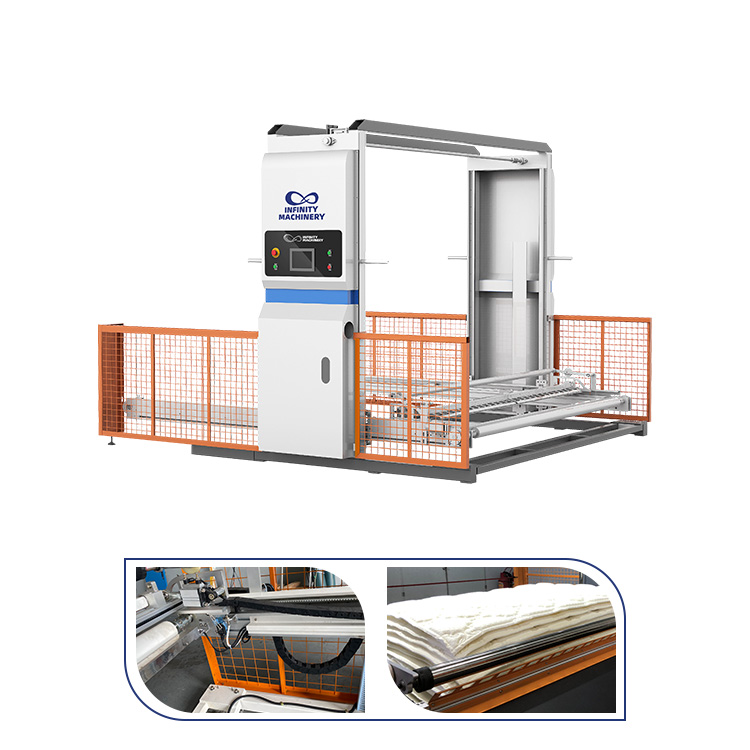
Discover the IF-QFS Automatic Quilted Fabric Stacking Machine from Infinity Foam Machinery. Crosscut, slit, and stack quilted fabric at 250 pcs/h with Panasonic touch-screen control. Works with any quilting machine.
QUILTING LINE UPGRADE
Stop Having Two People Cut Fabric. One Machine Does It at 250 Pcs/Hour.
The IF-QFS automates crosscutting, slitting, and stacking of quilted fabric — no extra hands needed
Fabric Stacking Automatic Cutting Labor Savings
If your quilting machine produces panels faster than your team can cut and stack them, you don't have a quilting problem. You have a bottleneck at the other end of the machine.
Walk into most mattress factories and you'll see the same scene: a high-speed quilting machine running at full capacity at one end, and two or three workers on the other end scrambling to cut, measure, stack, and move panels by hand. They're using tape measures, scissors, and manual knives. They're bending, lifting, carrying. And they're slowing down your entire production line.
The math is simple. A modern computerized quilting machine can produce 150 to 250 meters of quilted fabric per hour. A manual cutting and stacking team — even a good one — handles maybe 60 to 80 panels per hour before fatigue, measurement errors, and safety risks kick in. That gap is costing you throughput every single shift.
Here's what that lost throughput looks like in real numbers. If your quilting machine runs 8 hours per day at 200 m/h and your manual team can only process 70 panels per hour, you're leaving roughly 55% of your machine's capacity unused. At an average of $1.20 per panel in labor and material cost, that's $1,200 to $1,800 per week in unrealized output from just one production line.
The Manual Fabric Handling Problem
55%
of quilting machine capacity lost
2-3
workers tied up in cutting/stacking
$62-94K
annual lost output per line
What the IF-QFS Does
The IF-QFS Automatic Quilted Fabric Stacking Machine sits at the exit end of your quilting line and replaces the manual cutting and stacking station. It receives quilted fabric directly from the quilting machine, then performs three operations automatically: crosscutting to length, slitting to width, and edge trimming — then stacks the finished panels neatly at 250 pieces per hour.
It handles fabric widths up to 2,400 mm and can stack panels up to 1,800 mm high before the stack needs to be moved. The clamping mechanism secures panels with a 500 mm clamp length, ensuring consistent alignment throughout the stacking process.
IF-QFS Key Specifications
Max Fabric Width
2,400 mm
Max Stack Height
1,800 mm
Machine Size
3380×3230×2400 mm
Control
7" Panasonic Touch Screen
Automates crosscutting, slitting, edge trimming, and stacking of quilted fabric at 250 pcs/h. 7-inch touchscreen control.
View Product →
10 Features That Make a Difference on the Production Floor
The IF-QFS is not just a cutter with a stacking tray. It packs engineering details that matter when you run it 8, 10, or 16 hours a day:
1. Single-Stroke Crosscut
The crosscut blade cuts through the full fabric width in one pass, eliminating the return-travel delay found in reciprocating cutters. Every second saved per cut adds up to significant throughput gains over a full shift.
2. 7-Inch Panasonic Touch Screen
Large color touchscreen with intuitive controls. Operators set panel length, slitting width, and stacking parameters without memorizing codes or navigating complex menus. Training time: under 30 minutes.
3. Rapid Length Adjustment
The length-detecting sensor is adjusted via a manual wheel — fast and precise. Ideal for factories that frequently switch between mattress sizes (twin, full, queen, king) throughout the day.
4. Thin Material Detection
Equipped with sensors that detect even 5 mm thin materials. This means the machine handles lightweight border fabrics and thin quilted panels with the same reliability as thicker mattress panels.
5. Pneumatic Tension Rollers
Rollers with pneumatic tension device keep the fabric flat and aligned during feeding. This prevents wrinkles and misalignment that cause material waste and rework.
6. Toothed Synchronous Feeding
The feed-in top snubbed roller uses toothed synchronous material feeding technology. This ensures even pressure across the full fabric width and consistent feeding speed — critical for accurate cut lengths.
7. Pneumatic Blade Sharpening
Side blades are sharpened pneumatically — no need to stop the line and remove blades for manual sharpening. This keeps cutting quality consistent throughout the shift.
8. Slitter Safety Cover
CE-certified safety protection covers on all slitter blades. Meets international safety standards and reduces risk of workplace injuries — an increasingly important factor in factory compliance.
9. Box-Frame Construction
Box-shape machine body provides rigidity and vibration dampening. Precise cutting even at maximum speed. Less vibration means cleaner cuts and longer blade life.
10. Standalone or Integrated
Works in tandem with any quilting machine, or runs alone for pre-cut fabric rolls. This makes it suitable for both new production lines and retrofits to existing setups.
How It Completes Your Quilting Line
The IF-QFS is the missing piece between your quilting machine and your assembly line. Here's how a complete, automated quilting-to-stacking workflow looks:
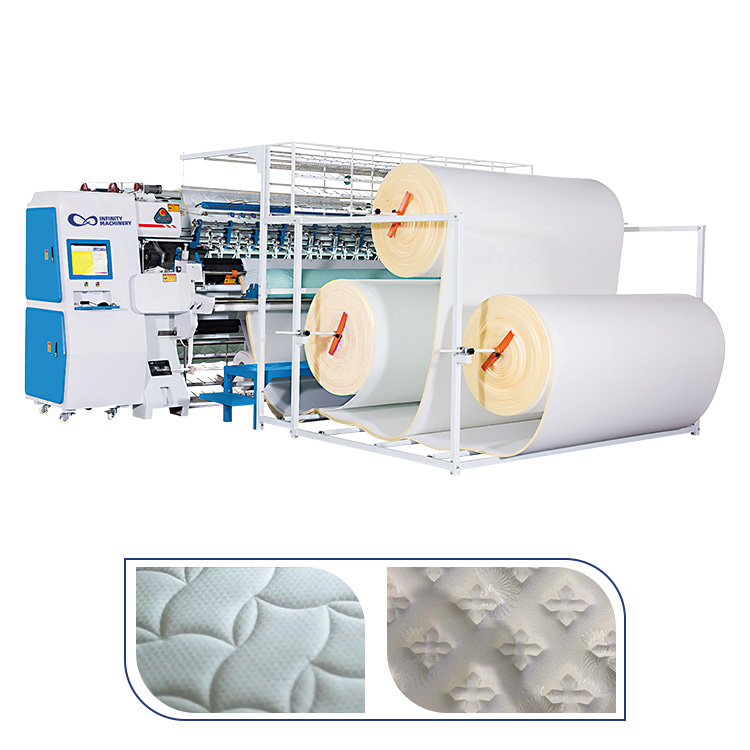
- Quilting — A machine like the IF-Q-1200 Computerized Quilting Machine feeds quilted fabric at high speed. Patterns are programmed digitally; the machine runs continuously with minimal operator attention.
- Crosscutting and slitting — Quilted fabric enters the IF-QFS, which crosscuts it to the programmed panel length and slits it to width simultaneously. The single-stroke blade completes each cut in under a second.
- Edge trimming — Side blades trim the fabric edges cleanly, removing loose threads and uneven borders. The result is a finished panel ready for the next production step.
- Automatic stacking — Panels are stacked on the IF-QFS's clamping mechanism, aligned and ready for pickup. The stack builds up to 1,800 mm before needing to be moved — roughly 150 to 250 panels, depending on thickness.
In this configuration, one operator can monitor both the quilting machine and the stacking machine. The operator's role shifts from manual cutting and lifting to quality inspection and machine supervision — a significantly more productive use of skilled labor.
Multi-needle chain stitch quilting machine for high-quality mattress panels. High running speed, low vibration, easy operation.
View Product →
ROI: What One IF-QFS Saves You Per Year
Let's put real numbers on it. If your factory runs one quilting line and currently uses two workers for manual cutting and stacking:
| Cost Factor |
Before IF-QFS |
With IF-QFS |
Savings |
| Cutting/stacking labor |
2 workers |
0.5 worker |
$18,000/yr |
| Machine utilization |
45% |
90%+ |
2× output |
| Material waste (mis-cuts) |
3-5% |
<1% |
$3,600/yr |
| Injury risk / downtime |
Moderate |
Low |
Reduced |
| Total annual savings |
|
|
$21,600+ |
And that's before accounting for the revenue from increased output. If the additional quilting capacity translates to just 20 more finished mattresses per day at $50 margin each, that's an extra $260,000 per year in gross profit — all from eliminating a bottleneck that most factories simply accept as normal.
Who Uses the IF-QFS?
🛏️
Mattress Manufacturers
High-volume panel production
🏭
Quilting Service Shops
Multiple pattern changeovers per day
📋
Production Line Integrators
Building automated mattress lines
📈
Expanding Factories
Doubling capacity without doubling headcount
A Note on Installation and Integration
The IF-QFS is designed for straightforward integration into existing production lines. It operates on standard 220V/60Hz single-phase power, drawing only 2.5 kW — a fraction of what your quilting machine consumes. The machine footprint is 3,380 × 3,230 × 2,400 mm, which fits comfortably alongside most quilting machines without requiring major floor space reallocation.
Setup typically takes one to two days, including mechanical positioning, electrical connection, and operator training. The touchscreen interface is available in multiple languages, and the system stores panel size presets for quick changeovers between product runs.
Is This Relevant to Your Factory?
Ask yourself these three questions. If you answer "yes" to any of them, the IF-QFS is worth a serious look:
☐ Are 2 or more workers dedicated to cutting and stacking quilted fabric?
If yes, you're paying for labor that a single machine can replace with higher accuracy and no fatigue.
☐ Does your quilting machine ever sit idle waiting for panels to be cleared?
Every minute your quilting machine waits is a minute of lost capacity that you've already invested in. The IF-QFS keeps the line moving at full speed.
☐ Do you frequently change panel lengths or fabric widths?
If your production run involves multiple mattress sizes, the IF-QFS's rapid adjustment system saves significant changeover time compared to manual reconfiguration.
The mattress industry is moving toward fully automated production lines. The gap between a partially manual line and a fully automated one is not as large as most factory owners think — and the payback period is shorter than you'd expect.
Ready to Unlock Your Quilting Line's Full Capacity?
Get a personalized assessment of your current quilting line efficiency. We'll calculate your bottleneck, show you the ROI of adding an IF-QFS, and recommend the best configuration for your production.