Here's a question most foam manufacturers don't ask until it hurts their bottom line: where does your foam scrap go?
Every day, your cutting lines produce off-cuts, trimmings, and defective blocks. Maybe you're stacking them in a corner. Maybe you're paying a waste hauler to take them away. Maybe — if you're like most factories we visit — you're watching 5 to 15 percent of your raw material vanish into a dumpster, month after month, year after year.
That's not just waste. That's money you already paid for, being thrown out twice — once when you bought the raw chemicals, and again when you pay someone to haul the scrap away.
And it's not a small number. A medium-sized foam block cutting operation running two shifts can generate 300 to 800 kilograms of foam scrap per day. At typical disposal rates of $0.30–$0.80 per kilogram, that's $90 to $640 every single day going straight to the landfill. Add that up over a year, and you're looking at $22,000 to $160,000 in pure waste — not counting the lost value of the material itself.
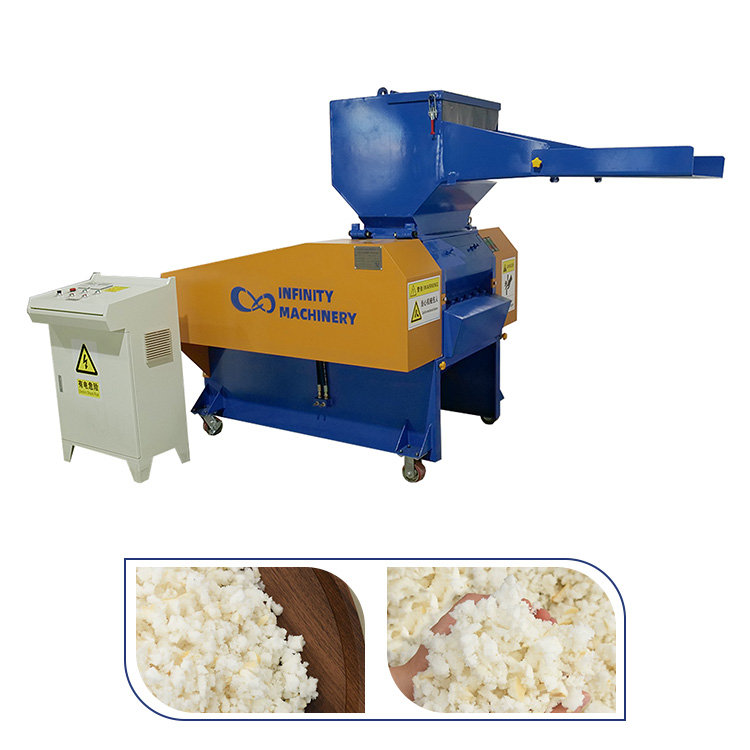
The solution isn't complicated, but it does require a shift in thinking. Instead of treating foam scrap as a disposal problem, you treat it as a raw material for a second product line. The key piece of equipment that makes this possible is a foam crushing machine — a machine designed specifically to take irregular scrap foam and reduce it to uniform, reusable granules.
Once crushed, those granules have real value. They can be:
The economics are straightforward: if you're producing 500 kg of scrap per day and paying $0.50/kg to dispose of it, that's $250 per day in disposal costs alone. A foam crushing machine that converts that same 500 kg into saleable granules at $0.40/kg generates $200 per day in revenue — a swing of $450 per day, or roughly $117,000 per year (based on 260 working days).
The IF-FFS3 Crushing Foam Machine (Super Power) is designed specifically for high-volume foam scrap processing. It handles not just soft polyurethane foam, but also cloth waste, film materials, yarn, and even harder foam types — making it one of the most versatile crushers in its class.
At the heart of the machine is a dual-cutter system: 4 lines of stationary cutters working in tandem with 3 lines of rotary cutters. This configuration provides aggressive, consistent shredding that handles everything from soft foam trimmings to dense block scrap. The cutting chamber is fed through a 650 × 500 mm inlet, large enough to accept most off-cuts and trim pieces without pre-cutting.
The discharge mesh size is adjustable from 8 to 40 mm, giving you control over the final granule size. Want coarse chips for packaging filler? Set it wide. Need finer granules for rebonding or filler applications? Switch to a smaller mesh. This flexibility means one machine can serve multiple downstream applications.
The IF-FFS3 isn't a laboratory machine. It's built for the dust, heat, and continuous operation of a real foam production floor. Here's what that means in practice:
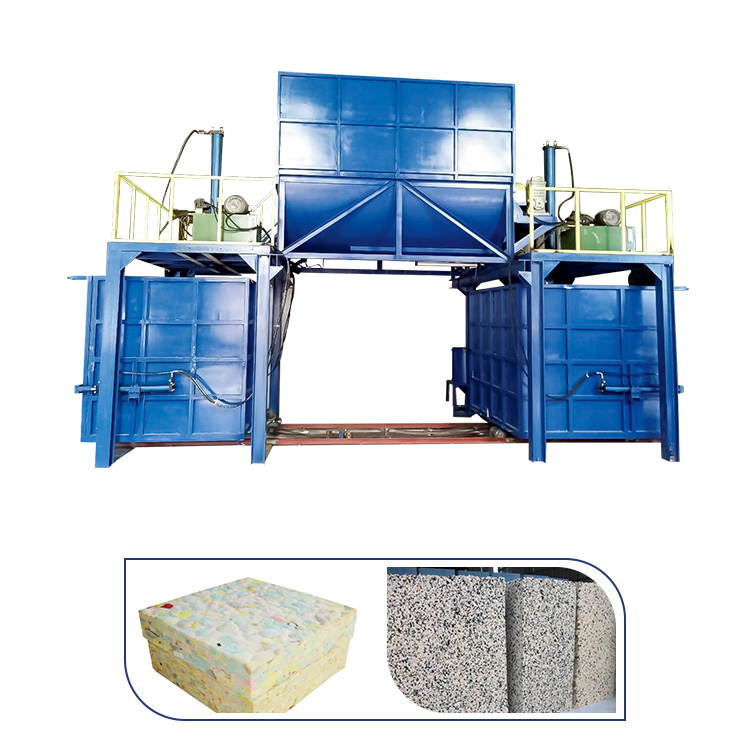
A crushing machine is the heart of a foam recycling setup, but it works best as part of an integrated system. Here's how a typical foam recycling line flows:
We've worked with foam manufacturers across Latin America, Southeast Asia, the Middle East, and Africa who installed crushing and rebonding lines. The feedback is surprisingly consistent — here's what they say:
"We were paying $350 a month for waste disposal. Now we sell our crushed granules to a packaging company for $0.35/kg. The machine paid for itself in 9 months."
"We produce rebonded carpet underlay for the local market. The IF-FFS3 gives us consistent granule size, which means consistent density in our final product. That was our biggest quality issue before."
"We run two IF-FFS3 units side by side — one for soft scrap, one for hard. Total throughput is about 2 tons per day. Our waste pile went from a mountain to zero."
If you're evaluating a foam crushing investment, here's a realistic ROI model based on a typical medium-volume foam cutting operation:
| Metric | Value |
|---|---|
| Daily foam scrap generated | 500 kg |
| Disposal cost saved ($0.50/kg) | $250/day |
| Revenue from crushed granules ($0.40/kg) | $200/day |
| Total daily swing | $450/day |
| Annual impact (260 working days) | $117,000/year |
| Estimated payback period | 6–12 months |
Even at half the scrap volume, the economics still work. A smaller operation generating 200 kg of scrap per day would see a daily swing of roughly $180 — translating to $46,800 per year in improved bottom line, with a payback under 18 months.
And here's something many buyers don't consider upfront: when you eliminate foam waste disposal, you also reduce your environmental footprint. Landfills charge by weight and volume. Polyurethane foam takes centuries to decompose. By crushing and recycling your scrap, you're not just saving money — you're building a cleaner production process that matters to increasingly eco-conscious B2B buyers.
Not every factory needs a crushing machine right away. Here's a quick self-assessment to help you decide if now is the right time:
Still unsure? That's normal. The right approach depends on your specific scrap volume, material mix, and local market for recycled granules. The best next step is to get a customized assessment based on your actual production data.
Get a personalized ROI analysis for your factory. We'll calculate your scrap volume, recommend the right machine configuration, and show you the payback period.