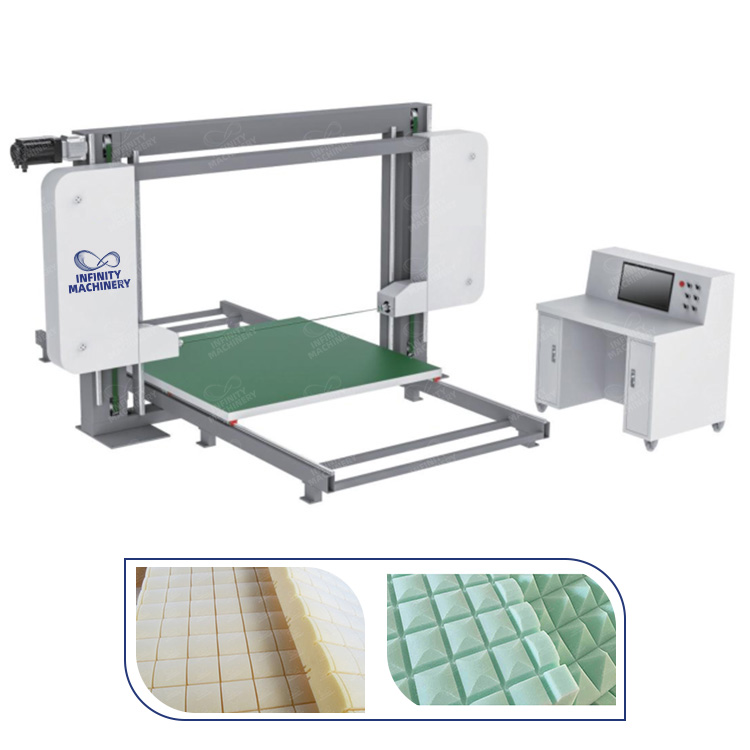
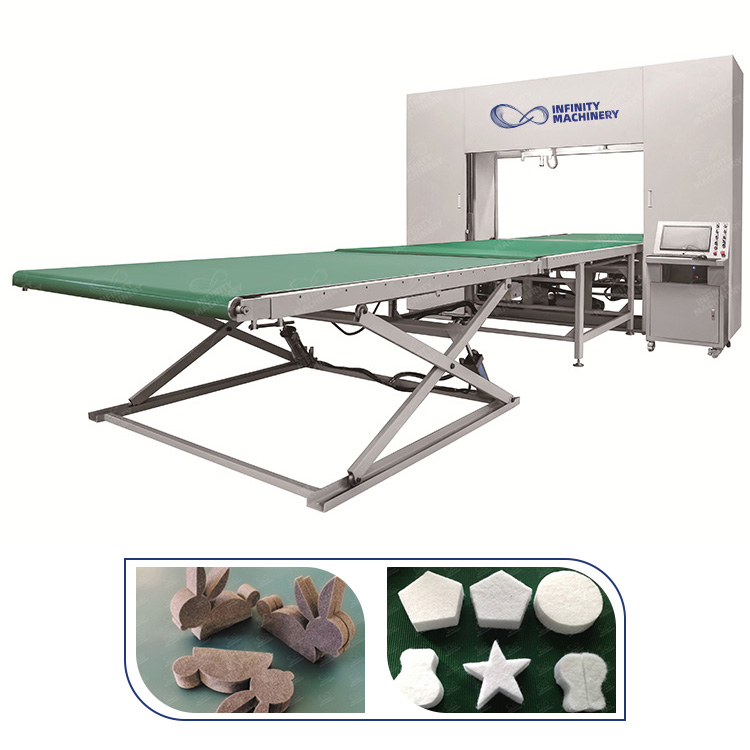
Most foam cutting operations lose 3 to 8 percent of their material to inaccurate manual cuts. On a $500,000 annual raw material spend, that's $15,000 to $40,000 disappearing into off-spec blocks and rework — every single year.
If you're still cutting foam blocks with manual guides, measuring tapes, and operator judgment, you're leaving that money on the floor. And it's not just material waste — it's also inconsistent product quality, slower throughput, and the constant headache of training new operators to cut accurately.
The solution is CNC-controlled cutting. And for horizontal block slicing — one of the most common and material-intensive operations in any foam factory — the IF-CNCH Horizontal Blade Foam Cutting Machine is designed to eliminate guesswork entirely.
Horizontal foam cutting — slicing large blocks into uniform sheets — is the foundation of most foam conversion operations. Mattress cores, cushion layers, packaging sheets, insulation panels: they all start with accurately cut horizontal slices. If those slices vary in thickness by even 2-3 mm, the downstream effects multiply — inconsistent product weight, uneven lamination, and higher scrap rates in subsequent operations.
A CNC-controlled horizontal cutter eliminates these variations at the source. The cutting parameters are programmed digitally and executed by servo drives with precision down to ±0.1 mm. The operator's role shifts from manually guiding the blade to loading blocks and monitoring the cut — a fundamentally different (and more productive) workflow.
The IF-CNCH is a PC-controlled CNC horizontal foam cutting machine designed for precision slicing of polyurethane foam blocks. It uses a continuous blade mounted on a horizontal carriage, guided by a servo drive system on high-precision linear rails. The result is consistent, accurate cuts with minimal operator intervention.
At the heart of the system is the PC controller, which supports X, Y, and C axis command settings. Operators can load cutting patterns directly from a PC — either standard sheet thickness programs or custom profiles for shaped cuts. The system tracks graphics on screen, so what you see is what the machine cuts.
Not all horizontal foam cutters are created equal. Here's what sets the IF-CNCH apart from basic manual or semi-automatic machines:
The IF-CNCH handles horizontal slicing. But many foam cutting operations also need vertical and contour cuts — for mattress profiling, packaging inserts, shaped components, and custom foam products. That's where a complementary CNC vertical cutter comes in.
The IF-CNCV Contour Sponge Cutting Machine (Vertical Knife) shares the same PC-based CNC control platform and servo drive technology as the IF-CNCH, but uses a vertical blade orientation for contour cutting, shape profiling, and 3D foam shaping. Together, the two machines cover the full range of foam cutting requirements — from basic sheet slicing to complex contour shapes.
Key advantages of pairing both machines:
Switching from manual or semi-automatic horizontal cutting to CNC control delivers returns in three measurable areas:
| Metric | Manual Cutting | IF-CNCH CNC | Improvement |
|---|---|---|---|
| Cutting tolerance | ±2-5 mm | ±0.1 mm | 20-50× better |
| Material waste | 3-8% | <1% | $14-39K saved/yr |
| Operator training time | 2-4 weeks | 2-3 days | 80% faster |
| Changeover time | 10-20 min | <1 min | 95% faster |
| Max sheets per hour | 30-50 | 60-100+ | 2× throughput |
| Estimated payback | — | 8-14 months | from savings alone |
And there's a less obvious benefit: consistent product quality builds customer trust. When your foam sheets are consistently within tolerance, your downstream customers — mattress manufacturers, packaging converters, and insulation fabricators — experience fewer rejects and less rework. That translates to stronger relationships and repeat orders.
The IF-CNCH is designed as a drop-in replacement for existing horizontal cutting operations. The machine footprint varies by configuration — standard models fit within the same floor space as a manual horizontal cutter of equivalent capacity. Electrical requirements are standard industrial three-phase power.
Setup typically takes two to three days, including mechanical assembly, PC system configuration, and operator training. The PC-based control interface is intuitive enough that operators with basic computer skills can begin productive cutting by day two of training.
Still unsure whether CNC horizontal cutting is right for your operation? Here's a simple self-check: if your monthly foam material spend exceeds $20,000, and you're currently cutting with manual or semi-automatic equipment, the ROI math almost certainly works in favor of CNC. The only question is how quickly you want to start capturing those savings.
Get a personalized ROI analysis for your cutting operation. We'll calculate your current waste rate, show you the savings from switching to the IF-CNCH, and recommend the best configuration for your production volume.