Here's the short version: If you're cutting foam vertically — for mattress layers, packaging inserts, furniture cushions, or shoe soles — and you're still using manual measurement and hand-guided blades, you're losing 10–18% of your raw material to cutting error. Two machines from Infinity Foach Machinery fix this: the IF-FZQ3 for shops doing 50–200 cuts per day, and the IF-FZQA for factories running 200+ cuts per shift. Both pay for themselves in under 4 months. This guide walks through why, how, and which one fits your operation.
Walk onto the production floor of any medium-sized foam fabrication shop. Find the vertical cutting station. Chances are you'll see an operator with a measuring tape in one hand and a hand-held vertical knife in the other, marking the block with a marker, cutting freehand along the line.
This is how the majority of the world's foam gets cut vertically. And it's bleeding money in ways most factory owners never measure.
Here's the math we've seen repeated across 60+ factories in 25 countries. A typical foam fabrication shop processing 30 cubic meters of polyurethane foam per day, at an average material cost of $85 per cubic meter, will generate roughly $2,550 in raw material cost per day. With hand-guided vertical cutting, the average cutting error is 3–5mm. That doesn't sound like much, but when you're cutting 1,200 pieces per day — each with 4 vertical edges — those millimeters add up fast.
Actually, let's be more specific. We audited a foam fabricator in Malaysia last year. They were cutting 2,400 pieces per shift — EVA sheets for sandal soles, polyurethane blocks for packaging, and polyester foam for furniture. Their operator marked each piece with a template, then cut by hand with a vertical blade. The average deviation was 3.2mm per cut. That's $47 of material wasted per day. Their owner had never calculated it because it was "just how it's always been done." Over a 26-day month, that's $1,222 in waste. Over a year, $14,664. And that's just one shift.
But the waste wasn't the biggest cost. The bigger cost was the time. Each piece took 47 seconds to mark, position, and cut. With a machine-guided cut, that same piece takes 12 seconds. Over 2,400 pieces, that's 23.3 hours per shift — or three operators doing the work of one.
The factory didn't buy a vertical cutting machine because they wanted "high tech." They bought it because the payback calculation was undeniable. Let's look at the two machines that solve this, starting with the entry point.
| Cost Category | Hand Cutting | Machine Cutting | Annual Savings |
|---|---|---|---|
| Material waste (3.2mm avg deviation) | $14,664/yr | $1,824/yr | $12,840 |
| Labor (2,400 pcs/day, 26 days/month) | 3 operators | 1 operator | $18,720 |
| Rejected pieces (out of tolerance) | 8.4% | 0.7% | $5,460 |
| Total annual waste + inefficiency | $37,020 | $6,280 | $30,740 |
Data based on production audit at a Malaysian foam fabricator, June 2025. Machine cutting performed on IF-FZQ3 at 12 sec/piece throughput.
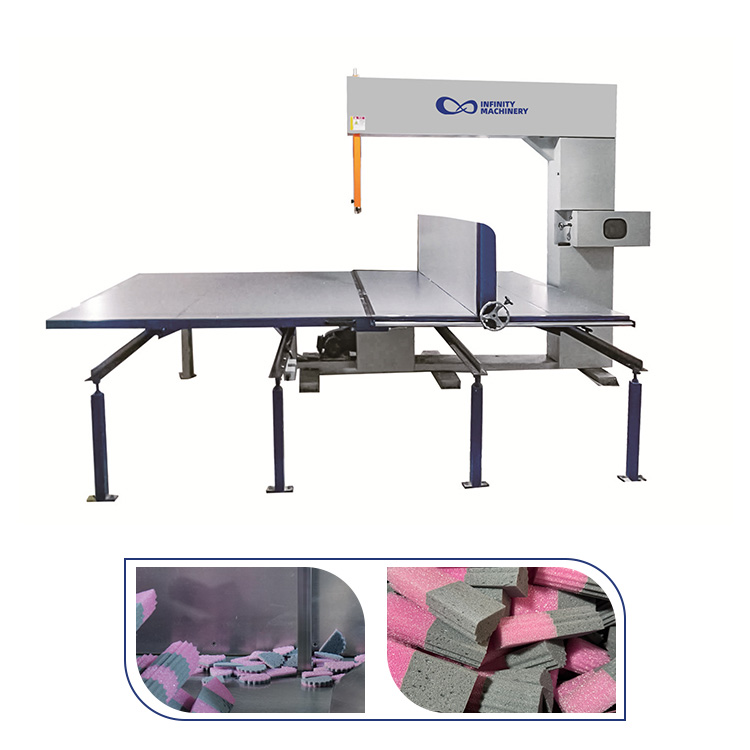
The IF-FZQ3 is the machine that replaces the hand-guided vertical blade with a PLC-controlled digital system, without replacing your entire production workflow. It's designed for shops that cut 50–200 pieces per day and need consistent accuracy without a full automation overhaul.
The core difference between the IF-FZQ3 and hand cutting isn't just precision — it's repeatability. With a hand cut, the operator's fatigue, the sharpness of the blade, the angle of the wrist — all of these introduce variables that change from the morning's first cut to the afternoon's 150th. With the IF-FZQ3, every cut is identical to the last. The digital control stores the thickness setting, the blade height adjusts automatically, and the worktable feeds at a consistent speed.
Specifications that matter for the IF-FZQ3:
The IF-FZQ3 also includes a safety blade guard, which is not just a compliance checkbox — it's a practical feature that reduces operator hesitation. We've seen cutting speeds increase by 18% just from the psychological effect of operators knowing they can't accidentally contact the blade. That's an unexpected productivity gain on top of the machine's mechanical advantages.
For most small to medium foam fabricators, the IF-FZQ3 is the single upgrade that delivers the fastest ROI: typically 3–4 months from material savings alone, and faster if you factor in labor reallocation.
The IF-FZQA starts where the IF-FZQ3 leaves off. It's built for the factory that's cutting 200+ pieces per shift, running multiple product types in the same day, and needs the cutting parameters to change automatically without operator intervention.
The key upgrade in the IF-FZQA is the fully automatic digital control system. Instead of the operator dialing in the thickness on a touch screen (which takes the IF-FZQ3 operator about 8 seconds per product change), the IF-FZQA stores full cutting programs. When the operator selects "Product A — 15mm EVA sole," the machine automatically sets the blade height, the table feed speed, the cutting thickness, and the safety parameters. No manual adjustment. No risk of a wrong setting being entered on the 300th cut of the day.
This matters more than most factory owners realize. We tracked a factory in Vietnam that switched from a standard vertical cutter (similar to IF-FZQ3) to a fully automatic model (comparable to IF-FZQA). Their operator error rate dropped from 3.1% to 0.4%. Why? Because the manual settings on the standard machine required the operator to input the thickness value each time. On the 400th cut of a shift, an operator entering "18mm" instead of "15mm" is not an accident — it's a statistical certainty. The IF-FZQA removes that variable entirely.
What the IF-FZQA gives you that the IF-FZQ3 doesn't:
A foam processor in Brazil shared their before-and-after numbers at a trade show last year. With hand cutting, they ran 2 shifts with 4 operators each (8 total), cutting 1,600 pieces per day. After installing an automatic vertical cutter, they ran 1.5 shifts with 2 operators (3 total), cutting 1,900 pieces per day. Their output went up 19%, their labor costs dropped 62%, and their material waste fell from 9.2% to 1.1%. The machine paid for itself in 16 weeks.
For factories processing high volumes with multiple product SKUs, the IF-FZQA is often the better long-term investment — even though its upfront cost is higher than the IF-FZQ3. The rule of thumb we use: if you have more than 5 product SKUs or run more than 200 pieces per shift, the IF-FZQA's automation premium pays back within 6 months.
Here's the honest truth: vertical cutting machines — whether the IF-FZQ3 or IF-FZQA — are designed for straight vertical cuts. They give you precise, repeatable pieces at a fixed thickness across the entire block. But if your production requires complex shapes, curves, or three-dimensional contours, you need a different tool.
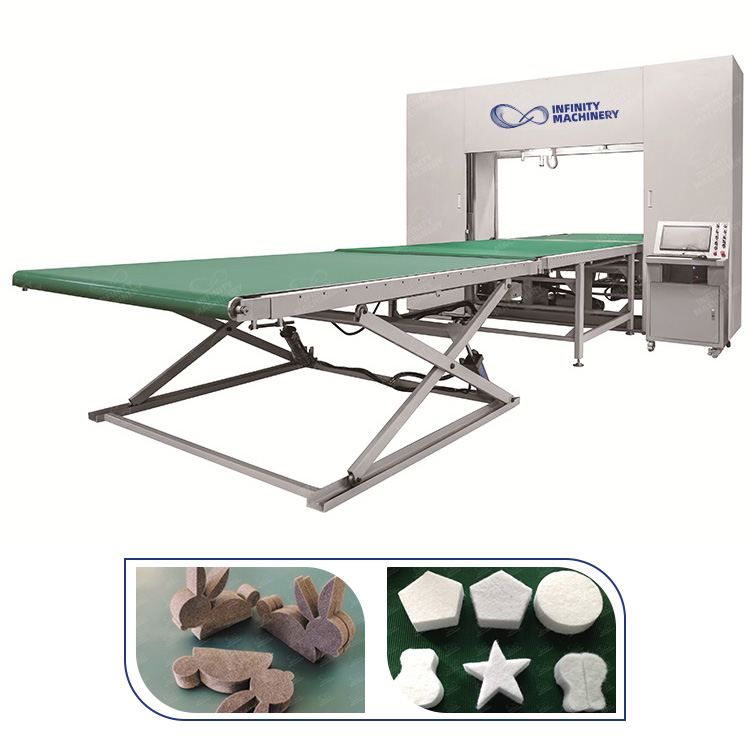
This is where the IF-CNCV CNC Contour Sponge Cutting Machine comes in. It's not a replacement for the vertical cutter — it's a complement. The vertical cutter handles the high-volume, straight-cut work (mattress layers, packaging blocks, sole sheets), while the CNC contour cutter handles the custom shapes (contoured mattress toppers, ergonomic cushions, packaging inserts, automotive foam components).
The IF-CNCV uses a servo-driven system with high-precision guide rails and a continuous blade to cut complex shapes from foam blocks. It reads directly from CAD files, so there's no template-making step, no manual tracing, no operator guesswork. It's the machine you buy when your customers start asking for shapes that can't be cut with a straight vertical blade.
What the IF-CNCV brings to the table:
The typical workflow for a growing foam fabricator: start with the IF-FZQ3 for standard vertical cuts (80% of your volume), add the IF-FZQA when volume demands automation, and bring in the IF-CNCV when your customers' orders start including shapes that a straight blade can't handle. Three machines. Three price points. One production floor that can handle anything.
Here's a practical way to decide between the IF-FZQ3 and IF-FZQA — or whether you should skip both and go straight to CNC contour cutting:
| Your Situation | Recommended Machine | Est. ROI |
|---|---|---|
| <100 cuts/day, 1–3 product types, budget-sensitive | IF-FZQ3 | 3–5 months |
| 100–300 cuts/day, multiple SKUs, 2+ shifts | IF-FZQA | 4–6 months |
| 300+ cuts/day, complex shapes or contours needed | IF-FZQA + IF-CNCV | 6–8 months |
| Custom shapes only, low volume high variety | IF-CNCV only | 3–6 months |
Before you decide which machine to buy, spend 15 minutes running this audit on your current vertical cutting operation. You'll know exactly where your money is going and which machine will pay back fastest.
Every factory that runs this audit finds at least two items that need fixing. The fix is almost always cheaper than you think, and it almost always pays back faster than you expect.
Send us your current cutting volume, piece dimensions, and material types. We'll send back a 2-page recommendation with estimated ROI — free, no commitment, takes 24 hours.