
You run a foam workshop, and you've got round foam blocks — the cylindrical leftovers from mattress core cutting, or the round buns from a batch foaming line. They're good foam, but they're the wrong shape. Cutting them into flat sheets by hand? Painfully slow. Slicing them on a standard horizontal cutter? Doesn't work for round stock.
So those round blocks sit in the corner, gathering dust, while you buy virgin foam sheets from a supplier at $X per cubic meter. You're losing money on foam you already own — simply because you don't have the right machine to convert it.
The IF-FYQ1 Foam Peeling Machine solves this. It peels round foam blocks into continuous thin sheets, like unrolling a giant roll of paper — only the paper is foam, and you control the thickness down to 1mm.
Think of it like a giant lathe for foam. You mount a cylindrical foam block on the machine, and as it rotates, a blade peels off a continuous, uniform-thickness sheet. The peeled sheet can then be rolled up for storage or sent directly to your production line.
This is fundamentally different from a standard foam cutting machine. Horizontal and vertical cutters slice blocks into individual pieces. A peeling machine creates one long, continuous sheet — up to 2150mm wide and as long as the block's circumference times the number of rotations. A single Ø2000mm × 2150mm round block peeled at 10mm thickness produces roughly 188 linear meters of foam sheet.
Here's where foam peeling is used across industries:
The IF-FYQ1 Foam Peeling Machine is a CNC-controlled rotary cutter designed for continuous peeling of round foam blocks. It's built for precision, reliability, and ease of operation.
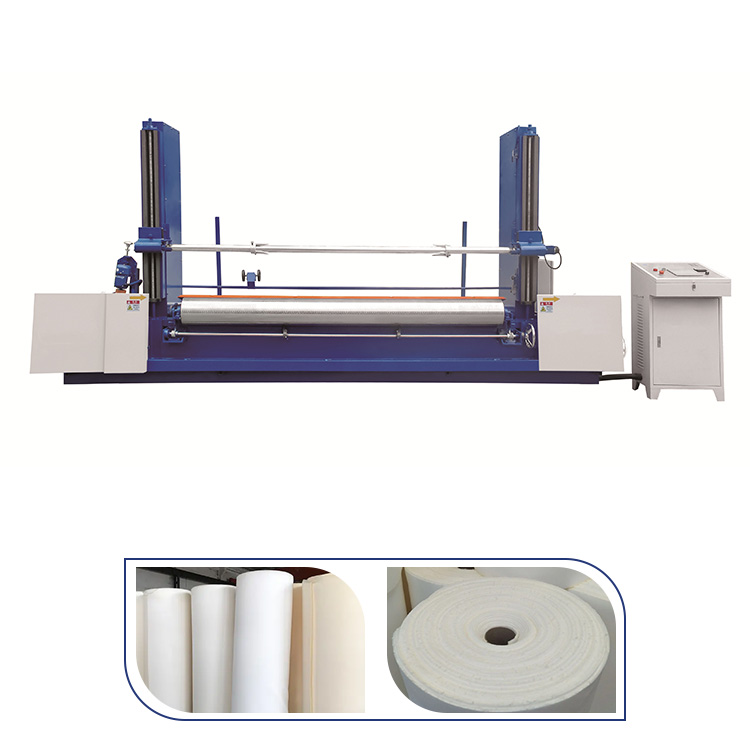
CNC-controlled rotary peeling machine for turning round foam blocks into continuous thin sheets. 1-30mm thickness, 0.1mm precision.
| Specification | IF-FYQ1 |
|---|---|
| Max Foam Size | Φ2000 × W2150 mm |
| Cutting Thickness | 1–30 mm (±0.1mm precision) |
| Turning Speed | 0–30 m/min |
| Blade Length | 8940 mm |
| Total Power | 4.67 kW |
| Control System | CNC PLC with Touch Screen |
| Machine Dimensions | L4600 × W1700 × H2000 mm |
| Output per Block (10mm thick) | ~188 linear meters |
The versatility of peeled foam sheets is what makes the IF-FYQ1 such a valuable addition to any foam workshop. Here are real products and the thicknesses that work best:
| Product | Peeled Thickness | Foam Density Range |
|---|---|---|
| Mattress toppers & comfort layers | 5–30 mm | 15–40 kg/m³ |
| Bra cups & lingerie padding | 1–5 mm | 20–35 kg/m³ |
| Shoe insoles & midsoles | 2–15 mm | 25–50 kg/m³ |
| Packaging foam sheets | 2–8 mm | 8–20 kg/m³ |
| Upholstery backing & dust covers | 3–15 mm | 12–25 kg/m³ |
Once your IF-FYQ1 has peeled a foam block into a continuous sheet, the foam comes off the machine as a rolled-up sheet. To store, transport, or further process these rolls, the IF-FCR3 Roll Foam Compressing Machine is your next step.
The IF-FCR3 compresses rolled foam sheets into dense, compact bales that take up 70-80% less storage space than loose rolls. This is especially valuable if you're peeling foam for later use or shipping peeled sheets to customers. A single skid of compressed foam rolls can hold the output of an entire shift of peeling — instead of filling a warehouse with bulky loose rolls.
What sets the IF-FYQ1 apart from older peeling machines is its CNC PLC control system with touch screen interface. Older peeling machines used mechanical gear adjustments to set thickness — you'd change gears, test a cut, measure the result, and repeat until you got close to your target. This was slow, imprecise, and required a skilled operator.
The IF-FYQ1 eliminates this entirely. Here's how the CNC system works in practice:
The touch screen can store up to 10 different thickness programs, so switching between products (e.g., 3mm for bra cups, 10mm for mattress toppers) takes seconds instead of the 15-20 minute gear change on older machines.
If you're evaluating whether a peeling machine or a conventional cutter is right for your operation, here's a practical comparison:
| Application | IF-FYQ1 Peeling | Horizontal/Vertical Cutter |
|---|---|---|
| Round/cylindrical blocks | Best choice | Not suitable |
| Thin sheets (1-5mm) | Excellent | Limited (≥2mm) |
| Consistent thickness across long sheets | Excellent | Good (per-block) |
| Rectangular blocks | Not suitable | Best choice |
| High-volume production (50+ blocks/day) | Excellent paired with IF-FCR3 | Excellent |
Q: "What shape does the foam block need to be?"
A: Round/cylindrical blocks work best. The IF-FYQ1 handles blocks up to 2000mm diameter and 2150mm wide. Blocks should be reasonably uniform in roundness — irregular shapes can be trimmed first on a standard cutter.
Q: "Can I peel different foam densities on the same machine?"
A: Yes. The IF-FYQ1 handles standard polyurethane foam from 8-80 kg/m³. The CNC system adjusts the cut parameters based on density. Switch between soft and firm foam by changing the program on the touch screen.
Q: "How long does it take to peel one block?"
A: For a typical Φ2000mm block peeled at 10mm thickness at a turning speed of 20 m/min, the actual peeling time is about 15 minutes. With setup and removal, figure 20-25 minutes per block.
Q: "Do I need the IF-FCR3 compressing machine right away?"
A: Not necessarily. You can run the IF-FYQ1 alone and store the peeled rolls as-is. The IF-FCR3 becomes valuable when you're either producing high volumes (50+ rolls/day) or shipping rolls to customers, where compression dramatically reduces freight costs.
| Factor | Without Peeling | With IF-FYQ1 |
|---|---|---|
| Round blocks utilized | 0% (waste/scrap) | 95%+ converted to sheets |
| Sheet thickness precision | ±2mm (hand cut) | ±0.1mm (CNC) |
| Output per shift | 5-8 blocks (hand cut) | 15-25 blocks |
| Material cost per sheet | $X (buying virgin sheets) | 40-60% less (using own foam) |
A pillow manufacturer in Vietnam bought an IF-FYQ1 to peel their excess round foam blocks into thin sheets for pillow fill. They were previously buying pre-made foam sheets from a supplier at $4.20/sheet. By peeling their own scrap round blocks, their cost dropped to $1.80/sheet. At 8,000 sheets per month, the machine paid for itself in less than 5 months.
If you're setting up a dedicated foam peeling operation, here are complementary machines to consider:
Tell us your block sizes, target sheet thicknesses, and volume. We'll show you exactly how the IF-FYQ1 fits into your production line — and what it will save you.
