
You're running a foam workshop. Blocks come in, customers want specific sizes, and you're cutting by hand or with a basic machine. Some cuts are clean. Most are not. You lose foam to waste — 5%, sometimes 10% of every block. Over a year, that's thousands of dollars in material you paid for but couldn't sell.
The fix isn't a bigger budget. It's choosing the right cutting tool for the job. Here's what three common foam cutting machines can do for your workshop — from a simple disc cutter to the fully automatic IF-FPQ1 horizontal slicer.
Short answer: yes. Hand-cutting foam with a knife or band saw works for small batches. But once you go past 20 blocks a day, the problems stack up fast:
The good news: you don't need to jump straight to a fully automated line. There's a cutting machine at every price point, and each one pays for itself faster than you'd think.
A disc foam cutting machine uses a rotating circular blade to cut foam boards and foam tubes. It's the simplest powered cutting tool you can add to your workshop. Here's what makes it useful:
A disc cutter is the first upgrade from hand cutting. If you're doing fewer than 30 blocks per day and your thickness tolerance is ±2mm, this is your most cost-effective option. Typical payback period: 3-6 months depending on volume.
A straight foam cutting machine uses a horizontally moving blade that cuts foam into long strips or regular shapes. It sits one step above the disc cutter in precision, especially for applications that need consistent dimensions across the entire length of a foam block.
A factory in Colombia producing mattress toppers switched from hand-cutting to a straight foam cutter and cut their waste rate from 9% to 3.5% in the first month. At 200 blocks per week, that recovered the machine cost in under 4 months.
The IF-FPQ1-1650/2150 Horizontal Foam Cutting Machine is where manual cutting ends and production efficiency begins. It's a fully automatic horizontal slicer that turns foam blocks into precise sheets with minimal operator input.
Here's how it works: you set the cutting thickness on the digital control panel, place the foam block on the worktable, and the machine runs automatically. The worktable moves back and forth while the blade cuts consistent slices at the programmed thickness. No hand-guiding. No guesswork.
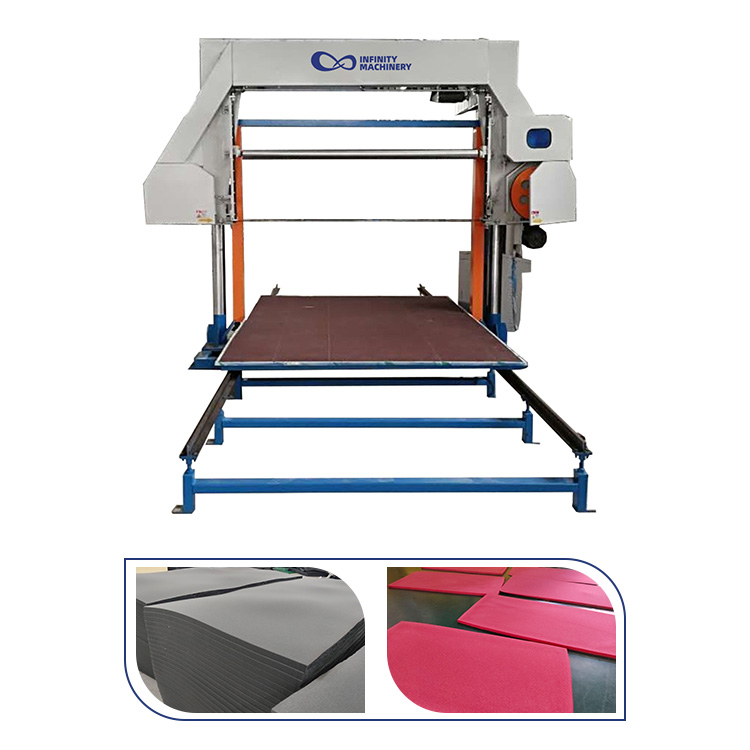
Fully automatic digital control for precise foam slicing. Set thickness, press start — the machine handles the rest.
View Product →| Specification | IF-FPQ1-1650 | IF-FPQ1-2150 |
|---|---|---|
| Max Foam Size | L2000 × W1650 × H1200 mm | L3000 × W2150 × H1200 mm |
| Cutting Thickness | 2–200 mm | 2–200 mm |
| Treading Speed | 0–30 m/min | 0–30 m/min |
| Blade Length | 8500 mm | 9480 mm |
| Total Power | 8.32 kW | 8.32 kW |
| Machine Size | L5000 × W3600 × H2350 mm | L7800 × W4200 × H2350 mm |
| Control System | Digital Control Box | Digital Control Box |
| Optional Equipment | Vacuum Table Available | Vacuum Table Available |
Here's a quick decision guide based on your production volume and needs:
| Your Situation | Recommended Machine | Estimated Payback |
|---|---|---|
| Under 20 blocks/day, basic shapes, tight budget | Disc Foam Cutter | 3–6 months |
| 20–40 blocks/day, need consistent strip dimensions | Straight Foam Cutter | 4–7 months |
| 40+ blocks/day, precise thickness (0.5mm tolerance) | IF-FPQ1 Horizontal Cutter | 6–10 months |
A mattress factory in Vietnam we worked with started with a disc cutter for small production, then added a straight foam cutter six months later, and finally upgraded to the IF-FPQ1-2150 after their output hit 60 blocks per day. Their total investment across 18 months was under $12,000, and they saved over $8,000/year in foam waste alone. Each machine paid for itself before they bought the next one.
Assume you run a small foam workshop processing 30 blocks per day, 22 days per month. Here's what upgrading from hand cutting to an IF-FPQ1 looks like:
| Metric | Hand Cutting | With IF-FPQ1 | Improvement |
|---|---|---|---|
| Blocks per shift | 10–15 | 40–60 | 3–4x faster |
| Material waste rate | 8–10% | 2–3% | -7% waste |
| Thickness tolerance | ±3–5mm | ±0.5–1mm | 5x more precise |
| Workers needed per shift | 2–3 | 1 | -50% labor |
| Monthly waste cost (est.) | $400–$700 | $80–$200 | Save $300–$500/mo |
The IF-FPQ1 typically pays for itself in 6 to 10 months — and that's counting only the material savings, not the labor reduction or the extra output you can sell.
Q: "Can I use the disc cutter for thick foam blocks?"
A: Disc cutters work best for foam up to 100mm thick. For thicker blocks, a straight cutter or the IF-FPQ1 horizontal slicer is more appropriate.
Q: "How long to train someone on the IF-FPQ1?"
A: About 30 minutes. The digital control system is straightforward — set the thickness, press start. Most operators are fully productive by the end of their first shift.
Q: "What foam densities can these machines handle?"
A: All three handle standard polyurethane foam (density 8–80 kg/m³). The IF-FPQ1 with optional vacuum table also handles softer foams (down to 4 kg/m³) without deformation.
Q: "Do I need a disc cutter first before upgrading to IF-FPQ1?"
A: Not at all. Many factories go straight to the IF-FPQ1 for its automation. The disc and straight cutters are lower-cost options if your budget is limited — but the IF-FPQ1 gives the fastest ROI at higher volumes.
Your foam cutting setup doesn't stop at horizontal slicing. Most efficient workshops combine multiple cutting machines for different stages of production. Here are three that pair well with the IF-FPQ1:
Tell us your daily block volume and foam types. We'll recommend the right machine — and show you the exact payback period.
