
A foam recycling plant in South Africa was buying virgin polyol and TDI to produce new foam blocks at $2.40 per kg. At the same time, they were collecting 6,000 kg of foam scrap per month from local mattress factories — and paying $0.08 per kg to have it hauled to a landfill. They installed the IF-FZS1 Re-Bonding Foam Machine (With Steam) and began converting their scrap into rebonded foam blocks. Total input cost: $0.55 per kg (including scrap collection, crushing, adhesive, and energy). Selling price of rebonded blocks: $1.80 per kg. Monthly profit from scrap: $7,500. They also added the IF-FFS3 crusher to process the scrap in-house rather than buying pre-crushed granules, further reducing input costs. Equipment cost for IF-FZS1: $16,500. Payback: 2.2 months.
The IF-FZS1/2 Re-Bonding Foam Machine is a hydraulic press with integrated steam injection, designed to convert crushed foam granules into solid rebonded foam blocks. The process is simple: foam granules are mixed with polyurethane adhesive, loaded into the mold, compressed under hydraulic pressure, and cured with steam injection. The steam accelerates the curing process, reducing cycle time to 8–12 hours compared to 24–48 hours for air-cured rebonding.
| Process | Mix granules + adhesive → press → steam cure → block |
| Steam Cure | 8-12 hours vs 24-48 hours air cure |
| Density Range | 30 to 120 kg/m³ — adjustable |
| Compression | Hydraulic — variable pressure for desired density |

The South African plant started with the IF-FZS1 and produced rebonded foam blocks in densities ranging from 30 kg/m³ (soft, for pillow filling) to 120 kg/m³ (firm, for gym mats and industrial packaging). The density is controlled by adjusting the amount of adhesive and compression pressure. Higher compression produces denser, firmer blocks. Lower compression with less adhesive produces lighter, softer blocks. This flexibility allowed the plant to serve multiple market segments from a single machine. The soft rebonded blocks sold to pillow manufacturers at $1.40/kg, while the firm blocks went to gym mat producers at $2.10/kg. By adjusting the density mix each week based on customer orders, the plant optimized its revenue — averaging $1.80/kg across all production.
| Cutting System | 4 stationary + 3 rotary cutter lines |
| Throughput | 150-300 kg/hour depending on density |
| Granule Size | 5-20mm adjustable via mesh screen |
| Materials | PU foam, cloth waste, film, yarn, harder foams |
Rebonding is the final stage of a three-step foam recycling process. Before the IF-FZS1 can produce blocks, the scrap foam must first be crushed into uniform granules. The IF-FFS3 Crushing Foam Machine (Super Power) handles this stage. It uses 4 lines of stationary cutters and 3 lines of rotary cutters to reduce foam scrap, cloth waste, and thrum into 5–20mm granules. The IF-FFS3 processes 150–300 kg per hour, depending on foam density. Imported cutting tools ensure consistent granule size and long service life — typically 2+ years between blade replacements. The machine handles PU foam, cloth waste, film, yarn, and harder foams, making it versatile for mixed scrap streams.
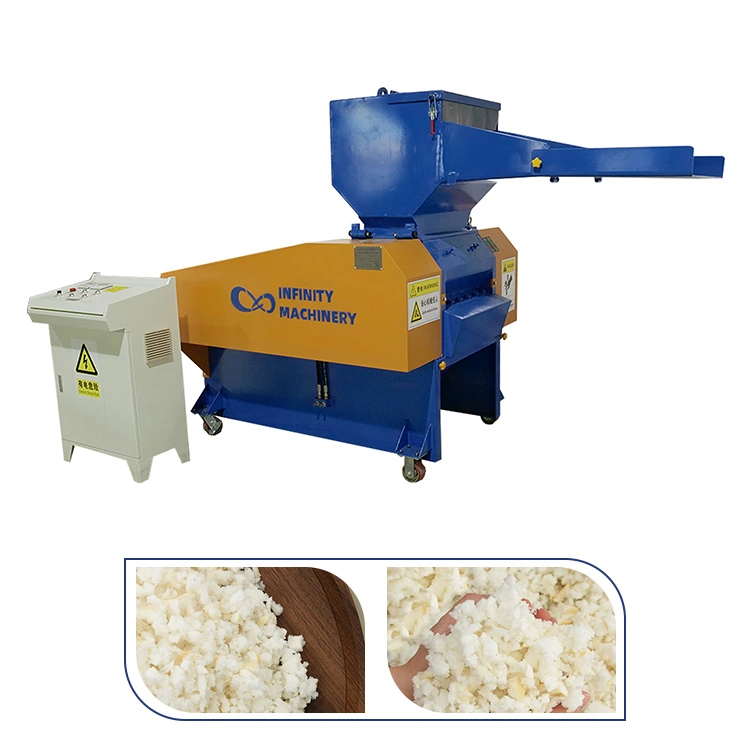
The IF-FFS3 — crushes foam scrap into uniform 5-20mm granules for rebonding
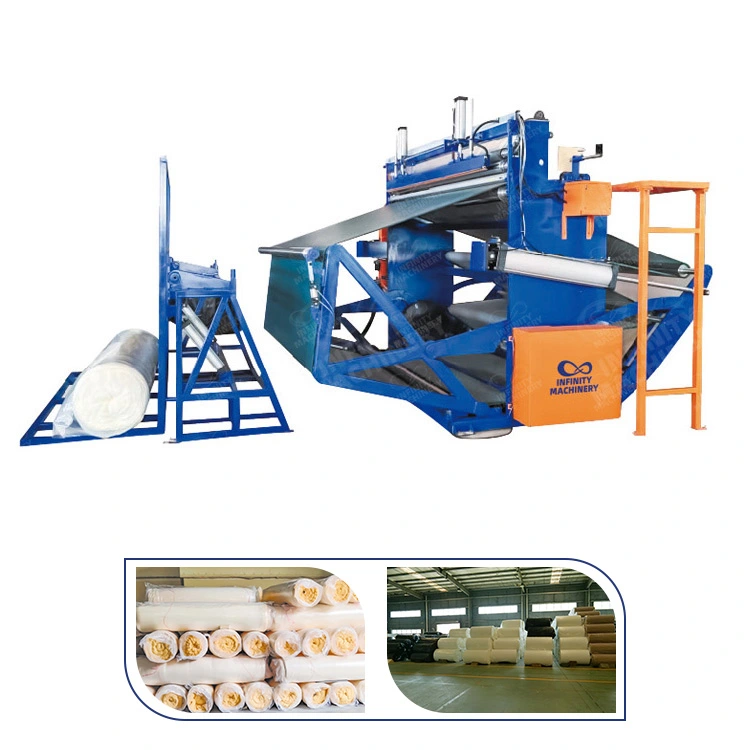
After crushing, the granules are fed into the IF-FZS1 for rebonding. The granules are mixed with 8-12% polyurethane adhesive by weight, loaded into the mold, compressed hydraulically, and cured with steam injection. The result is a solid foam block that can be cut into slabs, sheets, or custom shapes. The finished rebonded blocks can then be cut into slabs and compressed for shipping using the IF-FCR3 Roll Foam Compressing Machine, which reduces volume by 90% for efficient transport. The South African plant compressed their rebonded blocks into dense rolls before shipping to customers, reducing their shipping container needs from four to one per month.
| Machine | Investment | Function | Payback |
|---|---|---|---|
| IF-FFS3 Crusher | ~$12,800 | Crush scrap into 5-20mm granules | 4 months |
| IF-FZS1 Rebonder | ~$16,500 | Press granules into solid blocks | 2.2 months |
| IF-FCR3 Compressor | ~$6,500 | Compress blocks for shipping | 3 months |
Rebonded foam produced by the IF-FZS1 serves a wide range of markets. At lower densities (30-50 kg/m³), the blocks are used for pillow filling, cushion cores, and packaging inserts. At medium densities (50-80 kg/m³), they become carpet underlay, mattress base layers, and furniture padding. At higher densities (80-120 kg/m³), the blocks are used for gym mats, industrial packaging, acoustic panels, and horse stall mats. The South African plant sold to all three market segments, adjusting their production mix weekly based on customer orders. This diversification stabilized their revenue — when one market slowed down, another picked up. The plant achieved 92% capacity utilization within 6 months of starting production. Their customer base included 12 pillow manufacturers, 4 gym mat distributors, 3 packaging companies, and 2 acoustic panel producers.
Beyond the direct profit, the IF-FZS1 delivers significant environmental benefits. Each ton of rebonded foam produced keeps approximately 900 kg of foam scrap out of landfills. At the South African plant's production rate of 5,000 kg per month, that is 4,500 kg of waste diverted from landfill every month — 54,000 kg per year. The carbon footprint of rebonded foam is approximately 60% lower than virgin foam production, since the energy-intensive foaming process is replaced by mechanical crushing and adhesive bonding. For factories with sustainability targets or green certification programs, the IF-FZS1 provides a quantifiable environmental impact that can be used in marketing and compliance reporting. The combination of lower cost and lower environmental impact makes rebonded foam an increasingly attractive material for cost-conscious and eco-conscious buyers alike. Several of the South African plant's customers specifically sourced rebonded foam to meet their own corporate sustainability goals, paying a premium of 5-10% for recycled-content material.
Q: What foam types can the IF-FZS1 rebond?
A: Polyurethane foam of all densities. Softer foams produce lower-density rebonded blocks for pillows and cushioning. Higher-density foams produce firm blocks for gym mats and industrial packaging. The machine also handles mixed scrap from multiple sources, making it suitable for recycling plants that collect from various factories.
Q: How much adhesive is required?
A: Typically 8–12% polyurethane adhesive by weight, depending on the desired density. At 8% adhesive, the blocks are softer and more flexible. At 12%, they are firmer and more rigid. The IF-FZS1 includes an integrated mixing system that combines granules and adhesive evenly before pressing, ensuring consistent quality across every block. The adhesive cost typically represents 30-40% of the total input cost, with the remaining 60-70% being the scrap foam collection, sorting, and crushing costs.
Q: What is the block size?
A: Block dimensions depend on the mold size, which is customizable. Standard molds produce blocks approximately 1000 × 1000 × 1000 mm, weighing 80-120 kg depending on density. Custom mold sizes are available for specific end-product requirements. The blocks can be cut into slabs using a horizontal foam cutter or peeled into sheets using a foam peeling machine, depending on the final product application.
The IF-FZS1 Re-Bonding Foam Machine transforms foam scrap from a cost center into a profit center. Combined with the IF-FFS3 crusher and IF-FCR3 compressor, your factory can process scrap foam from collection to finished, shippable rebonded blocks. The complete three-machine system costs approximately $35,800 and pays for itself within 6 months for most factories generating 2,000+ kg of scrap per month. Even the IF-FZS1 alone, fed by existing granulated scrap supply, delivers a payback of under 3 months in most markets. Foam scrap is not waste — it is raw material you have not processed yet. With rebonded foam selling for $1.40-$2.10 per kg and input costs under $0.60 per kg, the margin speaks for itself. The only question is whether you will continue paying to dispose of your scrap or start turning it into profit. Contact Infinity Foam Machinery for a free consultation and ROI analysis for your specific scrap volume and market conditions. The IF-FZS1 is manufactured to order with a typical lead time of 25-35 working days. Installation and training take 3-5 days on site.
Get a free rebonding ROI analysis. We will calculate your scrap volume, adhesive costs, and projected revenue from rebonded foam blocks.
GET FREE ROI Consultar por WhatsApp