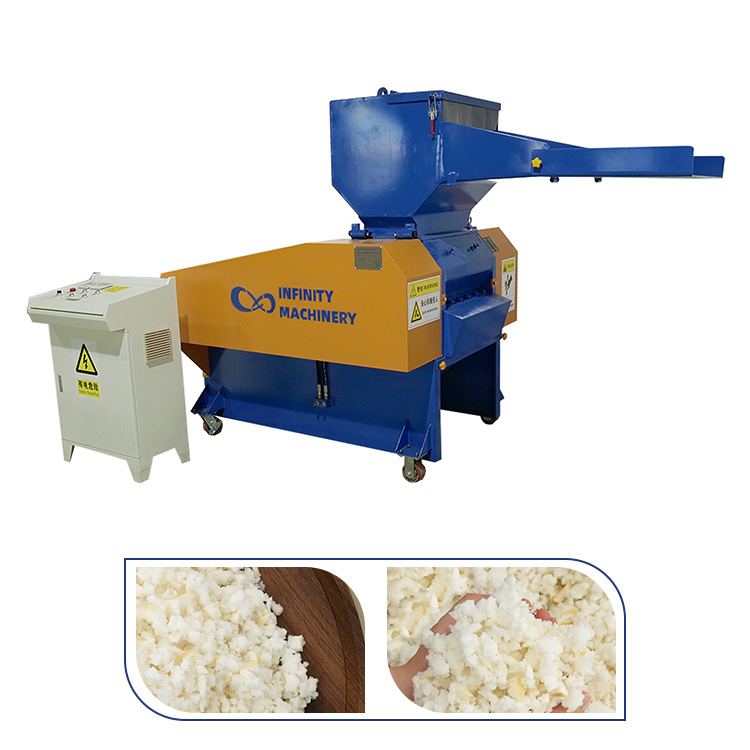
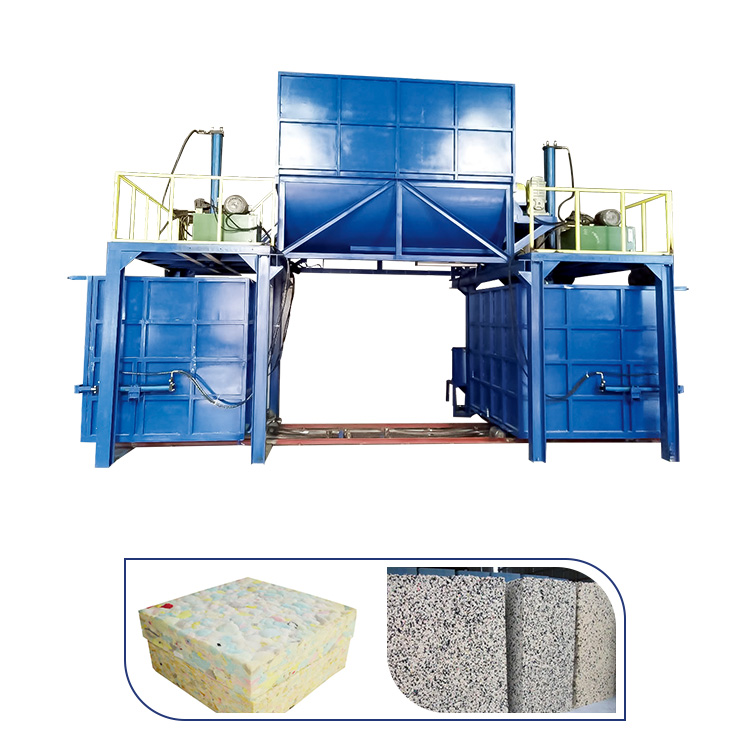
Here's the short version: Every foam factory generates scrap — trimmings, offcuts, defective blocks, edge strips. Most pay to have it hauled away at $50–$120 per ton. A growing number are turning that same scrap into $250–$1,200 per ton of finished product using two machines: the IF-FFS3 crusher and the IF-FZS1-2 rebonding press. This guide walks through the math, the machines, and the real factory results.
Walk to the back of your factory. Behind the cutting station, past the production line, next to the loading dock — there it is. A pile of foam scrap. Trimmings from block cutting. Offcuts from profile cutting. Edge strips from splitting. Rejected blocks from bad batches.
If you're like most foam factories, you're paying someone to haul it away. Landfill fees, transportation costs, maybe even environmental compliance. You've accepted this as a cost of doing business — "scrap happens, it's part of the process."
But here's what most factory owners miss: that pile isn't a cost center. It's a raw material warehouse you're paying to discard.
Let's do the math. A typical foam factory processing 500 tons of raw material per year — producing foam blocks for mattress, furniture, and packaging applications — generates approximately 15% scrap. That's 75 tons of foam scrap per year. At a conservative landfill cost of $80 per ton, that's $6,000/year you're spending to get rid of something you already paid for.
But here's the flip side. That same 75 tons of scrap, when properly processed, becomes a raw material worth $250–$350 per ton as foam granulate for rebonded foam production. That's $18,750–$26,250 in revenue from what was previously a $6,000 expense. Total swing: $24,750–$32,250 per year.
And if you take it one step further — turning that granulate into finished rebonded foam blocks for carpet underlay, gym mats, or packaging — the value jumps to $600–$1,200 per ton. At 75 tons, that's $45,000–$90,000 in finished product value. All from scrap.
The two machines that make this possible are straightforward, proven, and pay for themselves faster than almost any other equipment investment you can make. Here's how they work.
| Scenario | What You Do With 75 Tons | Annual Result |
|---|---|---|
| Landfill | Pay $80/ton disposal | -$6,000 |
| Crush only (IF-FFS3) | Sell as granulate at $250/ton | +$18,750 |
| Crush + rebond (IF-FFS3 + IF-FZS2) | Sell rebonded foam at $800/ton | +$60,000 |
Based on 500-ton/year foam factory with 15% scrap rate. Prices vary by region and foam density.
The IF-FFS3 is a heavy-duty foam crushing machine that reduces scrap foam — blocks, trimmings, offcuts, edge strips — into uniform granules. It's the front-end of any foam recycling operation: you can't rebond foam until you've crushed it into consistent particles.
The IF-FFS3 is designed for continuous industrial operation. It uses 4 stationary cutter rows and 3 rotary cutter rows to process scrap foam at high throughput. The stationary cutters provide the initial size reduction, while the rotary cutters refine the material to the target granulate size. The cutting action is clean — it shears the foam rather than tearing it, which produces cleaner edges and reduces dust.
What the IF-FFS3 handles:
The output granulate size is adjustable, typically ranging from 5mm to 15mm depending on your downstream application. For rebonded foam (carpet underlay, gym mats, packaging), the ideal granulate size is 5–10mm. For filling applications (pillows, bean bags, pet beds), 10–15mm is preferred.
The key metric for the IF-FFS3 is its throughput: it can process 150–300 kg of scrap foam per hour depending on density and feed rate. For the 75-ton-per-year factory we described earlier, that's roughly 1–2 hours of crushing per day. The rest of the shift can process the granulate into finished product or bag it for sale.
A factory in Indonesia that installed the IF-FFS3 told us their payback calculation: "We were paying $90 per ton for scrap disposal. The IF-FFS3 cost us $12,800 installed. In the first year, we saved $6,750 on disposal costs and sold 45 tons of granulate at $260/ton for $11,700 in revenue. Total benefit: $18,450. Payback was 8.3 months."
But crushing alone captures only a fraction of the value. The real transformation happens in the next step.
The IF-FZS1/2 is where the economics of foam recycling transform from "modest additional revenue" to "significant profit center." This machine takes the crushed foam granulate from the IF-FFS3, mixes it with adhesive binder, and presses it into rebonded foam blocks under hydraulic pressure with steam curing.
The rebonding process works like this: the granulate is mixed with a polyurethane binder in a rotating drum until each particle is evenly coated. The coated granulate is then loaded into a mold, where it's compressed by a hydraulic press. Steam is injected to accelerate the curing reaction, binding the particles together into a solid foam block. The resulting block can be cut, sliced, and shaped just like virgin foam — but at a fraction of the raw material cost.
The IF-FZS1/2 is available in two configurations:
What can you make with rebonded foam? The market is broader than most factory owners realize:
A factory in Mexico that installed both the IF-FFS3 and IF-FZS2 shared their numbers at a trade show: they process 8 tons of scrap per month. Their IF-FFS3 cost $14,000. Their IF-FZS2 cost $38,000. Total equipment investment: $52,000. In the first 12 months, they produced 85 tons of rebonded foam, sold at an average of $720/ton. Revenue: $61,200. Operating costs (binder, electricity, labor): $18,700. Net profit from scrap: $42,500 per year. Payback on the equipment: 14.7 months. "The scrap we used to pay to haul away is now our most profitable product line," the owner said.
The IF-FZS2 uses a hydraulic pressing system with steam injection that produces consistently dense, well-bonded blocks. The operator loads the mold, activates the press, and the machine completes the cycle automatically. Each cycle produces a block that can be cut into sheets or shaped for specific applications.
Once you've produced rebonded foam blocks from the IF-FZS1/2, you need a way to cut them into usable sheets, strips, or shapes. Rebonded foam is denser and tougher than standard polyurethane foam, which means it requires a sturdy cutting machine.
The IF-FZQA automatic vertical foam cutting machine is the ideal complement to your recycling line. It cuts rebonded foam blocks into precise sheets — for carpet underlay, gym mats, or packaging sheets — with automated digital control and consistent ±0.3mm accuracy.
The IF-FZQA stores cutting profiles for different products, so switching between "gym mat — 15mm" and "carpet underlay — 8mm" takes 2 seconds. This is critical in a recycling operation where you're producing multiple product types from the same raw material stream.
For factories that only produce rebonded foam as blocks or slabs (selling to downstream converters), the IF-FZQA may not be needed. But for factories that want to capture the full value chain — producing finished sheets and cut pieces for end customers — the IF-FZQA completes the recycling line.
Depending on your scrap volume and target market, here are the three most common recycling line configurations we recommend:
| Configuration | Equipment | Scrap Volume | Revenue/Year |
|---|---|---|---|
| Basic: Crush and sell | IF-FFS3 only | 30–75 tons/yr | $7,500–$18,750 |
| Standard: Crush + rebond blocks | IF-FFS3 + IF-FZS1 | 30–75 tons/yr | $24,000–$60,000 |
| Full line: Crush + rebond + cut | IF-FFS3 + IF-FZS2 + IF-FZQA | 75–150 tons/yr | $60,000–$120,000 |
Run this quick audit to calculate exactly how much your foam scrap is worth:
We've run this audit for over 40 factories. The average gap is $23,000 per year for the crush-only scenario and $67,000 per year for the full recycling line. Most factories recover their equipment investment within 12–18 months.
Send us your scrap volume, current disposal cost, and target application. We'll send back a personalized 3-page recycling ROI report with exact equipment recommendation and payback timeline — free, 24-hour turnaround.