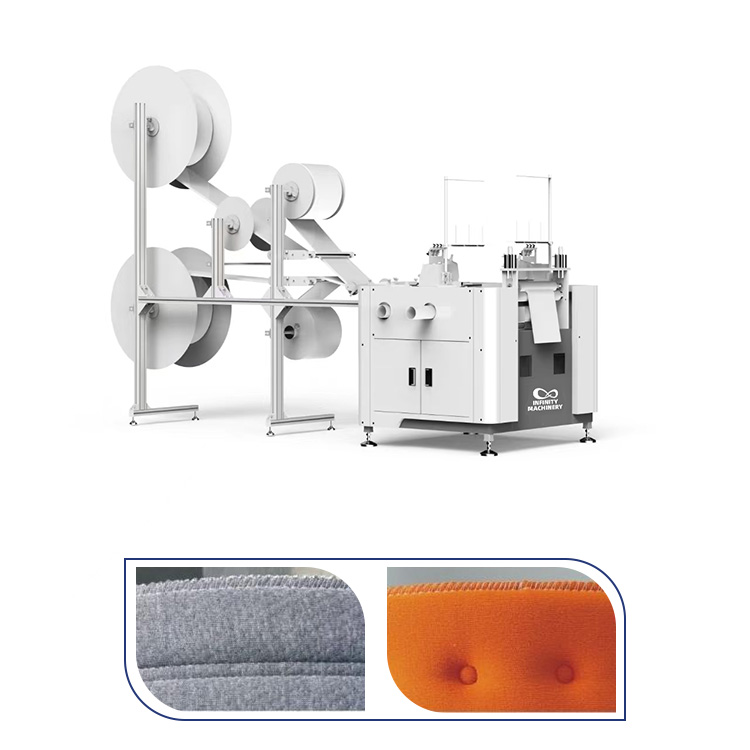
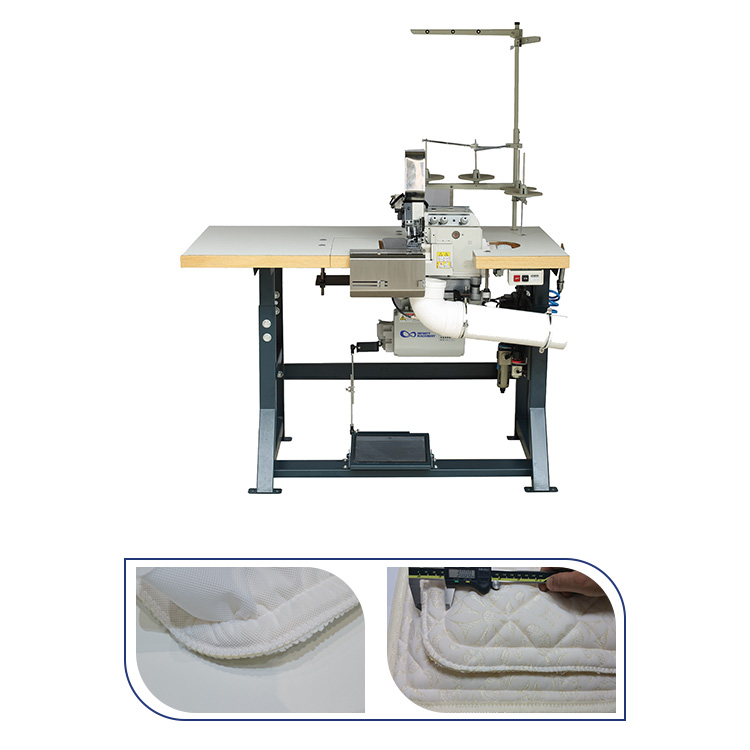
Here's the short version: Most mattress factories focus on the quilting, the spring unit, and the foam — the "invisible" quality. But the customer sees the border, the stitching, and the flange first. If those look bad, the mattress looks cheap, regardless of what's inside. The IF-SB-A2 sewing machine and IF-SBP80 flanging machine solve the three most common finishing defects: crooked stitching, uneven flanges, and slow production that creates overtime work.
Here's something mattress factory owners don't like to talk about: the finishing station — where the mattress gets its border sewn on and the flange trimmed — is where most quality defects are introduced. And those defects are what customers see first.
We analyzed return data from 12 mattress factories across three continents. The number one reason for customer returns was not spring failure, not foam degradation, and not quilting defects. It was finishing: crooked border stitching, uneven flanges, or fabric puckering at the corners. These cosmetic issues accounted for 34% of all customer returns — more than any other category of defect.
The average cost of a returned mattress — including shipping, inspection, refurbishment, and resale at a discount — is $38. For a factory producing 10,000 mattresses per year with a 4% return rate (the industry average), that's $15,200 per year in return costs directly attributable to finishing defects. And that's just the direct cost. The indirect cost — lost customer trust, negative reviews, and reduced repeat business — is estimated at 2–3x the direct cost.
The root cause? Most factories use general-purpose industrial sewing machines that weren't designed for mattress finishing. They lack the specialized features — double-heads for simultaneous front-and-back stitching, synchronized feeding for consistent flange width, and automated corner stitching — that prevent the defects that cause returns.
Two machines from Infinity Foam Machinery are designed specifically to solve these problems. Here's how they work.
| Defect Type | Share of Returns | Root Cause | Machine That Fixes It |
|---|---|---|---|
| Crooked border stitching | 14% | Single-head mismatch | IF-SB-A2 |
| Uneven flange width | 11% | Inconsistent fabric feeding | IF-SBP80 |
| Corner puckering | 9% | Manual corner handling | IF-SB-A2 |
| Loose thread ends | 8% | Auto-trimmer missing | IF-SBP80 |
| Fabric tear at seam | 6% | Incorrect needle/thread | IF-SB-A2 + IF-SBP80 |
| Total finish-related returns | 48% | Addressed by IF-SB-A2 + IF-SBP80 | |
Data collected from 12 mattress factories in Africa, Middle East, and Southeast Asia, Q1 2025–Q1 2026.
The IF-SB-A2 is a specialized mattress sewing machine with a unique design: it has two sewing heads that work simultaneously — one on the front side of the mattress border and one on the back side. This double-head design eliminates the most common defect in mattress sewing: mismatched stitching between the front and back of the border.
Here's why this matters. On a standard single-head sewing machine, the operator sews the front side of the border first, then flips the mattress and sews the back side. The problem is that the fabric shifts during the flip. The tension changes. The alignment drifts. By the time the operator has sewn both sides, the front stitching line is often 2–4mm offset from the back stitching line. On a premium mattress, that offset is visible — and customers notice it.
The IF-SB-A2 eliminates this entirely. Both heads are driven by a synchronized servo motor system. When the front needle advances, the back needle advances by the exact same amount. The stitching is identical on both sides. No offset. No alignment drift. No second pass.
Key features of the IF-SB-A2:
A factory in Kenya that switched from single-head machines to the IF-SB-A2 reported a 67% reduction in border stitching defects and a 40% increase in sewing station throughput. Their operator training time dropped from three weeks to four days because the machine's automatic features reduced the skill required to produce consistent results.
The IF-SB-A2 is the right choice for any factory that produces more than 50 mattresses per day and cares about border stitch quality. It's the single highest-impact upgrade you can make to your finishing line.
Once the border is sewn, the next step is the flange — the finished edge that runs around the top and bottom of the mattress. The IF-SBP80 is a heavy-duty flanging machine designed specifically for mattress production. It creates the clean, uniform edge that tells a customer "this is a quality mattress."
The IF-SBP80 uses a synchronous feeding structure that pulls the fabric through at a consistent speed and tension. This is the critical difference from general-purpose industrial sewing machines used for flanging — those machines rely on the operator to feed the fabric manually, which means the flange width varies depending on the operator's speed and consistency throughout the shift.
Why the IF-SBP80's feeding system matters:
A mattress manufacturer in Saudi Arabia reported that after adding the IF-SBP80 to their finishing line, their flange-related rejections dropped from 8% to 1.2%. The owner calculated that the machine saved them $1,800 per month in reduced rework and material waste — paying for itself in 4.5 months.
The IF-SBP80 is the right choice for any factory where flange quality is a differentiator — where customers compare the edge finish against competitors before making a purchase decision. In markets where retail customers can inspect multiple mattresses side by side, the IF-SBP80's consistent flange is a measurable competitive advantage.
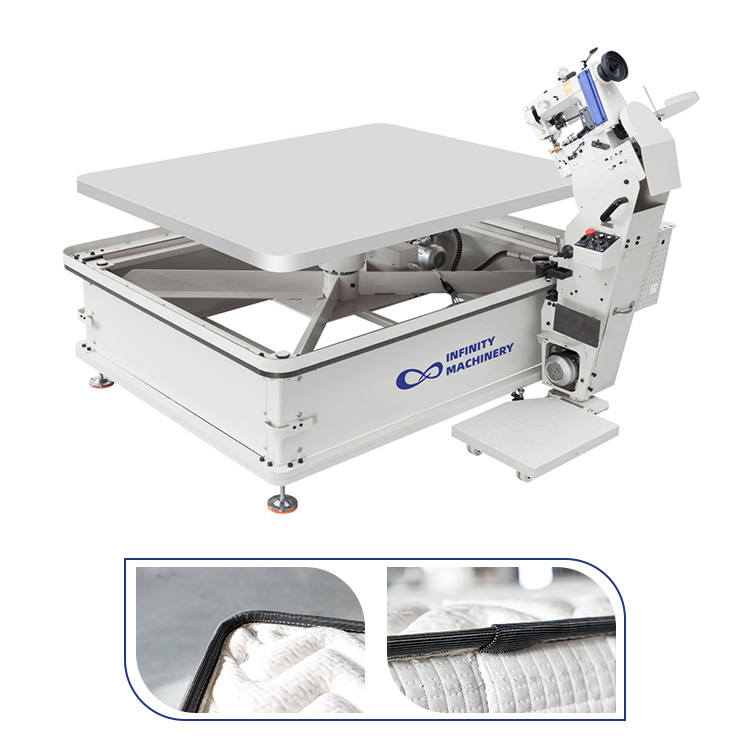
For factories that produce tape-edged mattresses (a popular style in many markets where the border is finished with a decorative tape), the IF-T3T chain stitch tape edge machine is the natural complement to the IF-SB-A2 and IF-SBP80.
The IF-T3T uses an advanced 300U chain stitch high-speed sewing head and an electric lift worktable. The chain stitch design is specifically suited for tape edge work because it creates a flexible seam that moves with the mattress — lock stitch seams can pop under tension, but chain stitch gives way without breaking.
The IF-T3T is the recommended third machine for factories that want to offer tape-edge mattresses alongside their standard flanged models. It fills the gap between the basic sewing station and the premium flanging station, giving you three finish options from one production floor.
Here's a practical cost comparison of three finishing station configurations we see in the field:
| Configuration | Defect Rate | Mattresses/Shift | Est. Investment |
|---|---|---|---|
| Generic single-head sewing machine only | 8–12% | 40–60 | $ |
| IF-SB-A2 sewing machine | 3–5% | 70–90 | $$ |
| IF-SB-A2 + IF-SBP80 (recommended) | 1–2% | 90–120 | $$$ |
| Full line: IF-SB-A2 + IF-SBP80 + IF-T3T | <1% | 120–150 | $$$+ |
Before you invest in new finishing equipment, run through this checklist:
In our experience, most factories find that item 2 (border alignment) and item 4 (cycle time) are the biggest hidden costs. The IF-SB-A2's double-head design addresses both simultaneously — it eliminates the alignment issue and increases throughput by 40–50% over single-head machines.
Send us photos of your current finishing station, your daily mattress count, and your top three defect types. We'll send back a 2-page analysis with specific machine recommendations and expected ROI — free, 24-hour turnaround.