
You have a mattress factory. You buy spring units from a supplier at $12–$18 each, wait 3–6 weeks for delivery, and pray the specs match your order. When they don't, you either use them anyway and risk returns, or scrap them and eat the cost.
That was the situation Carlos faced at his mattress plant in Bogotá, Colombia. He was spending $4,200 per week on pre-assembled Bonnell innerspring units and another $1,100 on pocket spring units — over $275,000 a year on springs alone. Lead times, minimum order quantities, and supplier errors were costing him an estimated $38,000 annually in lost production and scrap.
This guide walks through exactly how Carlos moved from buying pre-made spring units to producing them in-house. We will cover the three-stage workflow that cut his spring costs by 64%, eliminated supplier dependencies, and gave him full control over mattress quality — from raw wire to finished mattress core.
Every mattress factory that buys pre-made spring units faces the same three problems: cost markup (suppliers add 40–80% margin), lead time unpredictability (30–60 days with customs delays), and zero customization (you get what they make, not what you need).
Bringing spring production in-house solves all three. With the right equipment, a factory can convert a pallet of wire into finished mattress cores in under 4 hours, at roughly one-third the per-unit cost of buying from suppliers. The workflow breaks down into three clean stages:
The rest of this guide walks through each stage with real equipment options and production numbers.
The first step of any in-house spring line is converting raw wire into finished springs. For pocket spring production, the IF-P130-1 CNC Automatic Pocket Spring Coiling Machine is the starting point. This machine takes galvanized wire (typically 1.3–2.0 mm diameter) and produces pocket springs at speeds of up to 130 springs per minute.
The IF-P130-1 is fully CNC-controlled. Spring height, coil count, and wire diameter are programmed digitally, allowing you to switch between mattress models in under 5 minutes. The machine covers a very small floor area — about 2.5 square meters — making it practical even in cramped factory layouts.
| Output Speed | Up to 130 pocket springs per minute |
| Control | Full CNC — height, coil count, wire diameter programmable |
| Wire Diameter | 1.3–2.0 mm galvanized wire |
| Changeover Time | Under 5 minutes between mattress models |
| Floor Space | ~2.5 m² — fits in tight factory layouts |
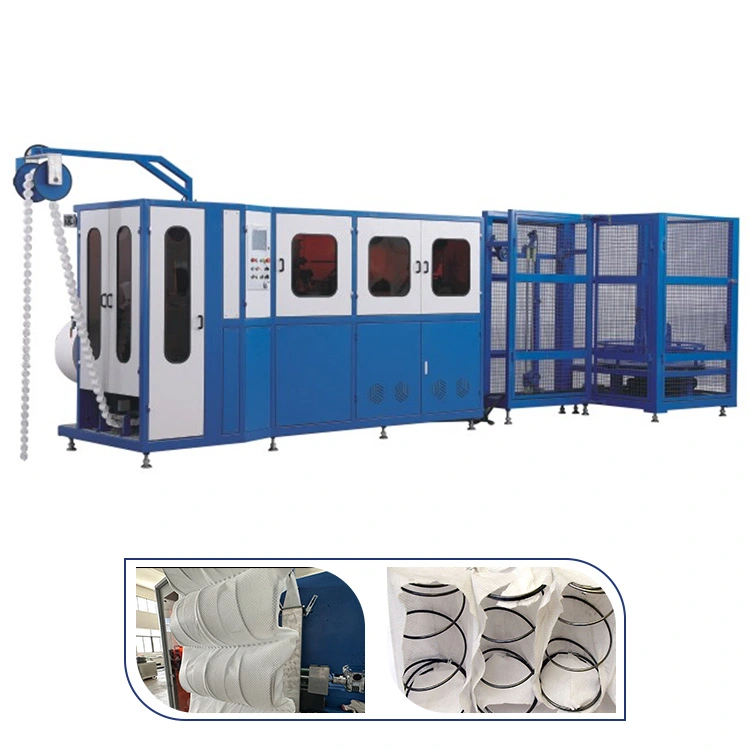
The IF-P130-1 — your starting point for in-house pocket spring production
A single IF-P130-1 running a standard 8-hour shift produces roughly 60,000 pocket springs — enough to build approximately 500 queen-size pocket spring mattress cores per month (assuming 120 springs per mattress). At a raw material cost of roughly $0.08 per spring (including wire and fabric), the per-mattress spring cost drops to under $10, compared to $15–$20 when buying pre-assembled units.
Having thousands of individual pocket springs is only useful if you can assemble them into completed mattress cores efficiently. This is where the IF-PPA Fully Automatic High Speed Pocket Spring Assembly Machine enters the workflow.
The IF-PPA takes individual pocket springs from the coiling machine and automatically arranges them into rows, applies hot-melt glue to bond adjacent springs, compresses the rows into a uniform mattress core, and outputs finished spring units ready for the next production stage. The entire process is fully automatic — one operator can monitor the machine and manage material supply.
| Operation | Fully automatic — feeds, aligns, glues, compresses, outputs |
| Drive System | Mechanical transmission + pneumatic, very low air pressure demand |
| Output | 1000–1200 spring units per 8-hour shift with 1 operator |
| Mattress Size Range | Adjustable for single to king-size, quick changeover |
| Floor Space | Very compact — fits alongside existing lines |
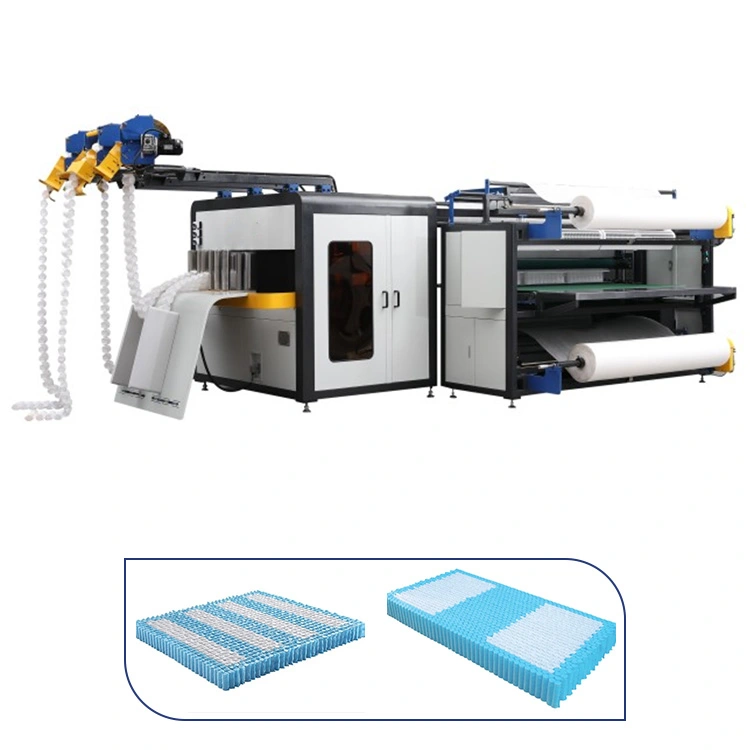
The IF-PPA — fully automatic assembly from individual springs to finished mattress cores
Carlos's factory installed the IF-PPA alongside the IF-P130-1. The two machines together formed a continuous pocket spring production line: wire went in one end, finished pocket spring cores came out the other. The result was a per-core cost of $9.80 (including wire, fabric, glue, and labor), versus the $18.50 he was paying his pocket spring supplier. The combined equipment cost of $38,500 was recovered in 3.2 months of production.
Not every mattress needs pocket springs. Bonnell (open-coil) spring units remain the standard for hotel mattresses, budget-friendly lines, and institutional bedding. For factories that produce both pocket and Bonnell mattresses — which is the majority — a complete in-house workflow must cover both spring types.
The IF-BA Automatic High Speed Bonnell Spring Assembling Machine is designed to complete the string combination of Bonnell (double cone) springs. It works in tandem with the IF-B90 Bonnell spring coiling machine: the IF-B90 produces the individual double-cone springs at up to 80 springs per minute, and the IF-BA takes those springs and automatically assembles them into finished innerspring units.
| Function | Automatic string combination of Bonnell double-cone springs |
| Compatible Coiler | Pairs with IF-B90 (80 springs/min output) |
| Efficiency | High working efficiency with simple, stable operation |
| Assembly Type | Helical wire lacing — industry standard for Bonnell units |
| Labor | 1 operator per machine — 2 operators for complete Bonnell line |
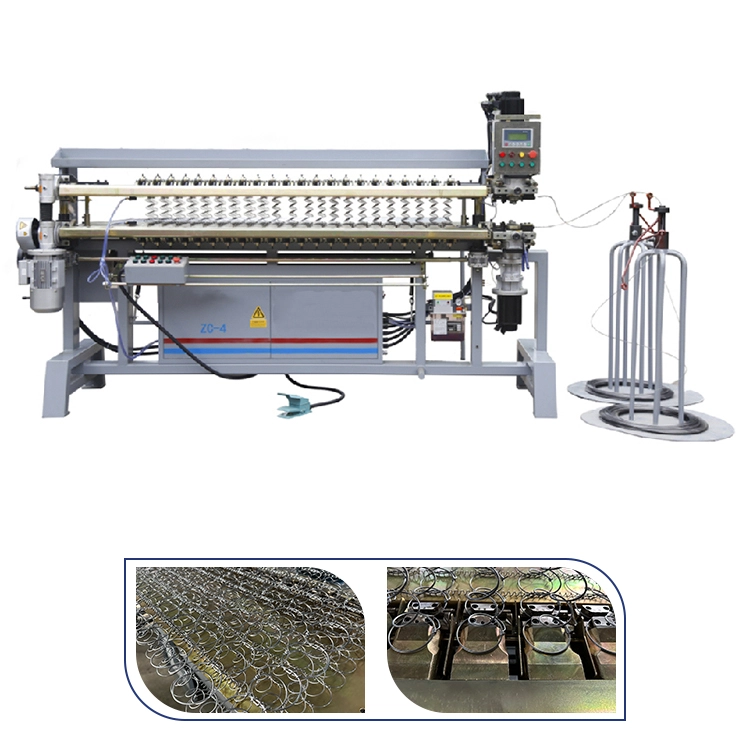
The IF-BA — automatic string combination for Bonnell spring units
Before bringing Bonnell production in-house, Carlos was paying $11.40 per Bonnell innerspring unit from his supplier. After installing the IF-B90 + IF-BA combination (total investment $31,200), his per-unit cost dropped to $4.10 — savings of $7.30 per unit. With his factory consuming roughly 3,400 Bonnell units per year, the annual savings exceeded $24,800, and the equipment paid for itself in 15 months.
The right setup depends on your product mix and production volume. Here is how to think about it:
| Scenario | Recommended Setup | Investment | Payback |
|---|---|---|---|
| Pocket spring only — under 300 mattresses/month | IF-PA (semi-auto assembly) + pocket coiler | ~$25,000 | 4-6 months |
| Pocket spring only — over 300 mattresses/month | IF-P130-1 + IF-PPA (full auto) | ~$38,500 | 3-4 months |
| Bonnell spring only | IF-B90 + IF-BA | ~$31,200 | 12-15 months |
| Both pocket + Bonnell | IF-P130-1 + IF-PPA + IF-B90 + IF-BA | ~$69,700 | 8-12 months |
For most mid-sized mattress factories producing 500–2000 mattresses per month across multiple product lines, the sweet spot is the combined pocket + Bonnell workflow. The total investment of under $70,000 is typically recovered within a year through material cost savings alone — not accounting for secondary benefits like eliminated lead times, zero supplier defects, and full specification control.
Beyond the direct cost savings, Carlos discovered several operational advantages that he had not fully anticipated:
We hear the same questions from factory owners considering this move. Here are direct answers:
"Isn't it cheaper to just buy from Asia?" — Not by the time you account for freight, customs, MOQ padding, and defect handling. In-house production using raw wire (a globally traded commodity) eliminates every layer of supplier markup.
"We don't have skilled technicians to run these machines." — The IF-P130-1 and IF-PPA are CNC-controlled with intuitive interfaces. Training takes 2–3 days. The IF-BA is equally straightforward — one operator can learn it in a week.
"Our volume is too low to justify the investment." — At 150–200 mattresses per month, the savings on Bonnell or pocket spring units alone typically justify the equipment within 12–18 months. Above 300 mattresses, the payback drops under 6 months.
Q: Can I use the same wire for both pocket and Bonnell springs?
A: Typically not — pocket springs use thinner wire (1.3–1.6 mm) while Bonnell springs require thicker gauges (1.8–2.4 mm). However, both types are widely available from any steel wire supplier, and switching between them on the same machine takes only a guide adjustment.
Q: Do I need a separate glue system for pocket spring assembly?
A: The IF-PPA includes an integrated hot-melt glue application system. No additional glue equipment is needed. The IF-BA uses helical wire lacing (no glue required).
Q: How much floor space do I need for a complete spring line?
A: A complete pocket spring line (IF-P130-1 + IF-PPA) occupies roughly 8 m². A Bonnell line (IF-B90 + IF-BA) takes about 10 m². Combined, you need approximately 20 m² for both lines — about the size of a single shipping container.
Carlos's story is not unusual. In the 18 months since he installed his in-house spring assembly workflow, his factory has grown from producing 180 mattresses per month to 620. The ability to respond to custom orders within days instead of weeks directly contributed to winning three major hotel contracts that had been out of reach under the old supplier-dependent model.
The transition from buying spring units to producing them in-house is one of the highest-ROI moves a mattress factory can make. The equipment is proven, the workflow is straightforward, and the numbers speak for themselves — 64% cost reduction, 3–4 month payback on pocket spring lines, and complete control over your most critical mattress component.
Every factory starts at a different volume and with different product mix. The right first step is to calculate your current annual spring expenditure, then compare it against the equipment costs and per-unit production costs outlined in this guide. For most factories making 150+ mattresses per month, the math works in favor of bringing spring assembly in-house.
Get a personalized ROI calculation for your factory. We will analyze your current spring costs, recommend the right machine setup, and show you exact payback timelines.
