
If your foam factory produces 2,000 mattresses per month, you are generating roughly 500–800 kg of foam scrap every day — trimmings, offcuts, edge strips, defective blocks. Most factories pay to have this hauled away, typically $80–$150 per ton. That means you are spending $1,200–$2,400 per month just to get rid of material you already paid for. This guide shows you how three machines can turn that cost center into a profit center worth $30,000–$80,000 per year.
Turning foam scrap into profit requires three steps: compression for volume reduction and transport, crushing into uniform granules, and rebonding those granules into new foam blocks. Each stage adds value, and each uses a dedicated machine that pays for itself within months.
The IF-FCR3 Roll Foam Compressing Machine is the simplest way to start monetizing foam scrap. It takes loose foam trimmings and compresses them into dense, easy-to-handle bales. A single operator can process several hundred kilograms of scrap per hour.
| Function | Compresses loose foam scrap into dense roll bales |
| Volume Reduction | Up to 90% — turns mountains of scrap into compact rolls |
| Operation | Single operator, simple controls, low maintenance |
| Output | Dense bales that stack for storage or ship as raw material |
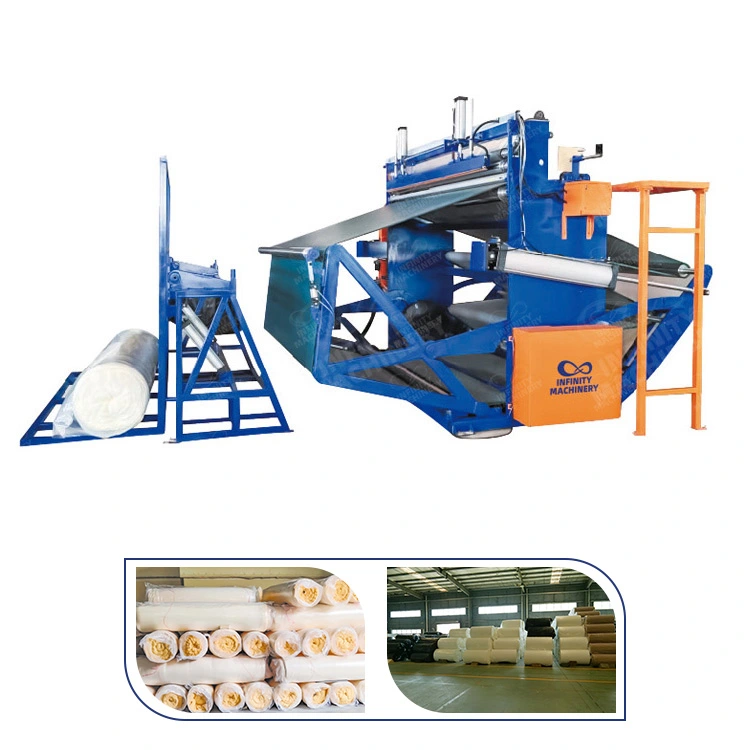
The IF-FCR3 — compress loose scrap into dense bales for storage or sale
A factory in Vietnam using the IF-FCR3 told us: "We were paying $200 per month for scrap disposal. After compressing with the IF-FCR3, we now sell our compressed bales to a local recycling company for $120 per ton. We process about 5 tons per month — that's $600 in revenue instead of $200 in costs. The machine paid for itself in 4 months."
Once you have consistent scrap volume, the IF-FFS3 Crushing Foam Machine (Super Power) takes your recycling operation to the next level. This machine uses 4 lines of stationary cutters and 3 lines of rotary cutters with imported cutting tools to reduce foam scrap, cloth waste, and thrum into uniform granules.
| Cutting System | 4 stationary + 3 rotary cutter lines, imported cutting tools |
| Throughput | 150–300 kg/hour depending on foam density |
| Granule Size | Adjustable 5–20mm via mesh screen change |
| Materials | PU foam, cloth waste, film, yarn, harder foams |
| Maintenance | Imported bearings and cutters — 2+ years between replacements |
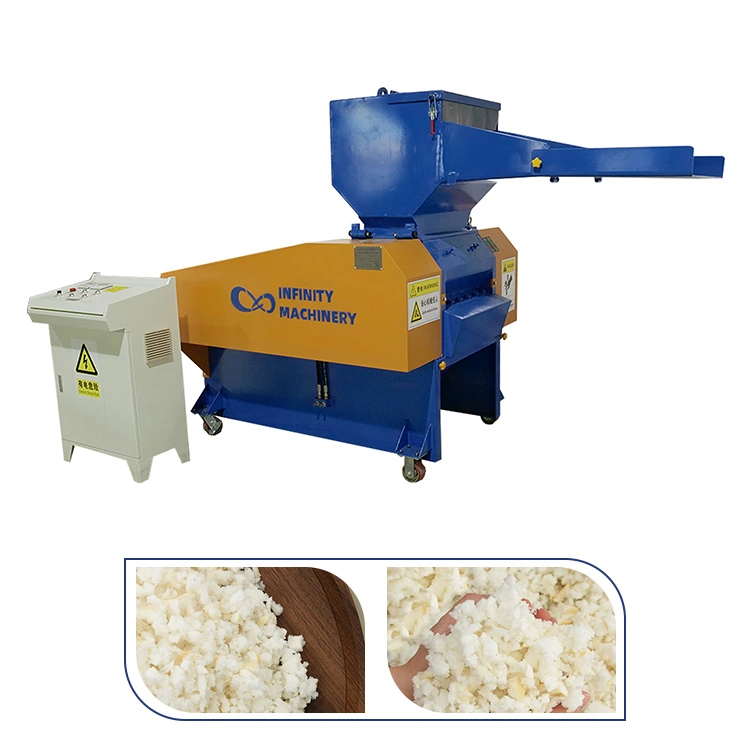
The IF-FFS3 — crushes scrap foam into uniform, high-value granules
At a throughput of 200 kg/hour, a single IF-FFS3 running 4 hours per day can process 800 kg of scrap — enough to handle the daily waste of a factory producing 2,500–3,000 mattresses. The granules sell directly to carpet underlay manufacturers, packaging producers, and rebonding facilities at $0.40–$0.60 per kg. That is $320–$480 per day in potential revenue from material you used to throw away.
The IF-FZS1/2 Re-Bonding Foam Machine (With Steam) closes the recycling loop. It takes the crushed granules from the IF-FFS3, mixes them with polyurethane adhesive, and presses them into solid rebonded foam blocks under hydraulic pressure with steam curing.
| Process | Mix granules with adhesive → hydraulic press → steam cure → solid block |
| Density Control | Adjustable — produce soft, medium, or firm rebonded foam |
| Output | Solid foam blocks ready for cutting into finished products |
| Steam System | Integrated steam injection accelerates curing to 8–12 hours |

The IF-FZS1/2 — turns foam granules into valuable rebonded blocks
A foam block manufacturer in Malaysia installed the IF-FZS1 alongside the IF-FFS3 and IF-FCR3. They were spending $14,000 per month on raw materials while generating 3,500 kg of scrap per month. The recycling line converted their waste into 2,800 kg of rebonded foam blocks per month, selling for $1.80 per kg. After deducting $1,200 in adhesive and energy costs, the net monthly profit from scrap was $3,840. Equipment payback: 8 months.
Not every factory needs all three machines. Here is how to decide based on your scrap volume:
| Scrap Volume | Recommended Setup | Investment | Monthly Revenue | Payback |
|---|---|---|---|---|
| 100–300 kg/week | IF-FCR3 only | ~$6,500 | $130–$260 | 3-4 months |
| 300–1,000 kg/week | IF-FCR3 + IF-FFS3 | ~$19,300 | $600–$1,400 | 5-8 months |
| 1,000+ kg/week | IF-FCR3 + IF-FFS3 + IF-FZS1/2 | ~$35,000 | $2,400–$4,800 | 6-12 months |
Here is what a medium-sized foam factory achieved with the complete three-machine recycling line:
Q: Is rebonded foam only good for low-end products?
A: Not at all. Rebonded foam made with the IF-FZS1/2 can be produced in densities ranging from 30 kg/m³ (soft, for pillow filling) to 120 kg/m³ (firm, for gym mats and industrial packaging). The density is controlled by the amount of adhesive and compression pressure.
Q: Do I need separate dust collection for the crusher?
A: The IF-FFS3 is designed with an integrated dust management system. However, for high-volume operation, we recommend connecting it to your existing shop dust collection for optimal air quality.
Q: Can I recycle cloth waste mixed with foam?
A: Yes. The IF-FFS3 handles cloth waste, yarn, and film materials in addition to PU foam. However, for rebonding, we recommend keeping foam-only granulate for highest quality blocks. Cloth-containing granules are better sold directly as filler material.
The beauty of this recycling system is that you do not need to buy all three machines at once. Start with the IF-FCR3 to stop paying for disposal and start earning from scrap. When you have consistent volume, add the IF-FFS3 to multiply your revenue per kg. Close the loop with the IF-FZS1/2 when you want maximum value from every kilogram of foam that enters your factory.
For a factory producing 2,000+ mattresses per month, the complete three-machine system pays for itself within a year and generates $50,000–$80,000 in annual net profit from what was previously a cost. Even smaller factories with 300 kg/week of scrap can start with the IF-FCR3 alone and see a 3–4 month payback.
Foam scrap is not a waste problem. It is a raw material stream you have not started processing yet.
Get a personalized recycling ROI report for your factory. We will calculate your scrap volume, recommend the right machines, and show you exact payback timelines.
