
Your foam production line has three stages that determine your throughput, quality, and profit margins: peeling foam blocks into continuous sheets, cutting those sheets to precise dimensions, and compressing finished products for shipping. Most factories treat these as separate operations with separate workflows. But when you integrate them into a single processing line, you eliminate handling waste, reduce labor, and cut per-unit costs by up to 35%. This guide covers the three essential machines that form a complete foam processing line.
A complete foam processing line converts raw foam blocks into finished, ready-to-ship products through three stages:
The IF-FYQ1 Foam Peeling Machine is a rotary cutting machine that peels cylindrical foam blocks into continuous thin sheets. It is widely used in mattress production, packaging materials, footwear components, and chest circumference padding. The machine handles foam blocks up to 2000mm in diameter and 2150mm in width.
| Max Foam Size | Φ2000 × W2150 mm |
| Cutting Thickness | 1–30 mm (±0.1mm precision) |
| Turning Speed | 0–30 m/min, stepless speed control |
| Applications | Mattress layers, packaging, chest padding, shoe materials |
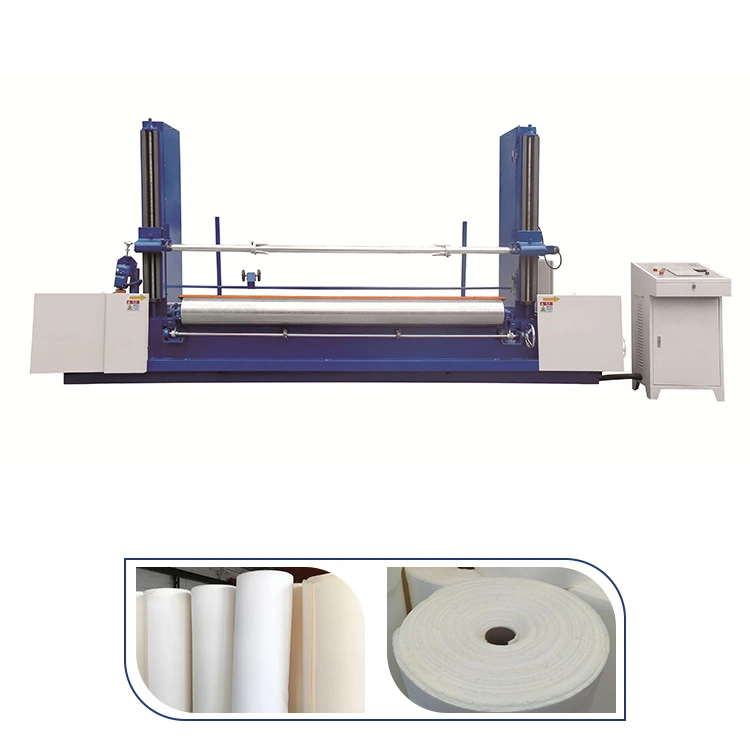
The IF-FYQ1 — peels continuous thin sheets from foam blocks with ±0.1mm precision
A mattress factory in Turkey producing 1,200 mattresses per month was buying pre-cut foam sheets from a supplier at a 45% markup. They installed the IF-FYQ1 and began peeling their own foam blocks into mattress layers. The machine paid for itself in 5 months. Their peeling costs dropped to $0.12 per sheet versus the $0.35 they were paying externally. With monthly sheet consumption of 28,000 units, the savings exceeded $6,400 per month.
Once foam is peeled into sheets or needs to be cut into dimensionally accurate slabs, the IF-LT1650/2450 Horizontal Long Track Foam Cutting Machine delivers the precision required for finished products. The distinguishing feature of this machine is its long track system that guides the blade carriage on both ends — keeping the blade parallel to the cutting bed at all times and preventing the blade drift that causes uneven slab thickness.
| Cutting Width | 1,650mm (IF-LT1650) / 2,450mm (IF-LT2450) |
| Guidance System | Dual-rail long track — blade guided on both ends |
| Blade Drive | Variable-speed motor, auto-adapts to foam density |
| Control | Fully automatic digital — set thickness, machine cuts |
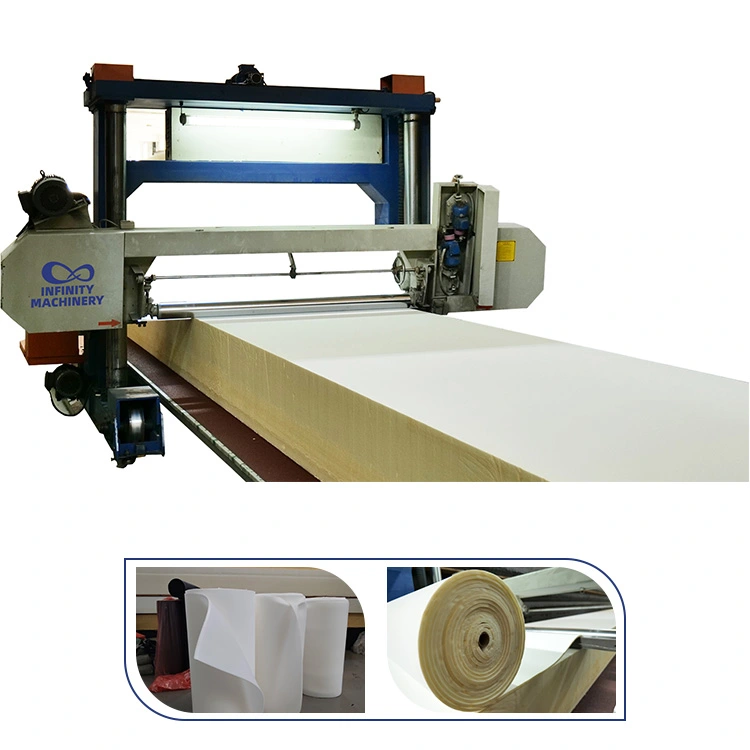
The IF-LT1650 — dual-track guidance delivers ±1mm accuracy across the full cutting width
The factory that installed the IF-FYQ1 also added the IF-LT1650 to handle their slab cutting needs. Previously they were outsourcing slab cutting to a local processor at $0.08 per cut. With 15,000 cuts per month, that was $1,200 in external processing costs. After bringing it in-house with the IF-LT1650, their per-cut cost dropped to under $0.02. Combined with the IF-FYQ1 savings, the two machines reduced overall foam processing costs by 58%.
After peeling and cutting, finished foam products need to be shipped. The IF-FCR3 Roll Foam Compressing Machine compresses peeled foam sheets, cut slabs, and finished products into dense rolls that take up 90% less space. This dramatically reduces shipping container requirements and warehousing costs.
| Function | Compresses foam products into compact rolls |
| Volume Reduction | Up to 90% — fits more product per container |
| Operation | Single operator, simple controls, low maintenance |
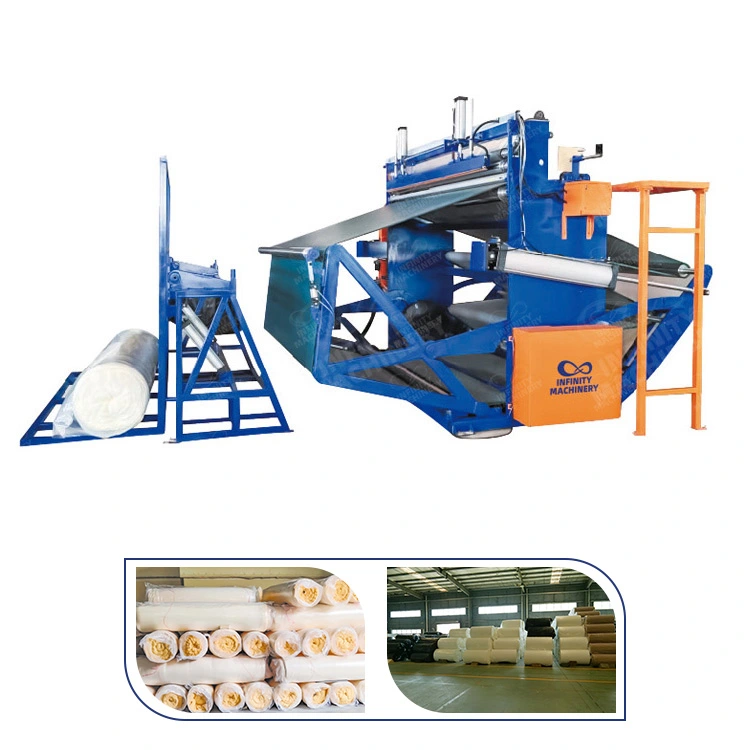
The IF-FCR3 — compresses peeled and cut foam into dense rolls for efficient shipping
The Turkish factory added the IF-FCR3 to complete their processing line. Before compression, they were shipping 60 m³ of foam products per month in three 20-foot containers at $3,800 per container. After compression, the same volume fit into one container — reducing monthly shipping costs from $11,400 to $3,800. The IF-FCR3 paid for itself in less than 3 months through shipping savings alone.
Here is what the three-machine processing line delivered for the Turkish mattress factory:
| Machine | Investment | Monthly Savings | Payback |
|---|---|---|---|
| IF-FYQ1 Peeling | ~$14,500 | $6,400 | 2.3 months |
| IF-LT1650 Cutting | ~$18,000 | $900 | 20 months |
| IF-FCR3 Compressing | ~$6,500 | $7,600 | 0.9 months |
| Total | ~$39,000 | $14,900 | 2.6 months |
The combined investment of $39,000 was recovered in just 2.6 months. After that, the processing line generated $14,900 per month in savings — $178,800 per year — from reduced material costs, eliminated outsourcing, and lower shipping expenses.
Not every factory needs all three machines immediately. The right starting point depends on your current bottleneck:
Q: Can the IF-FYQ1 peel different foam densities?
A: Yes. The stepless speed control allows the operator to adjust peeling speed based on foam density — slower for high-density foam, faster for soft foam. The ±0.1mm precision is maintained across all densities.
Q: How much space do I need for all three machines?
A: The complete line requires approximately 30 m². The IF-FYQ1 occupies ~6 m², the IF-LT1650 needs ~12 m² (including infeed/outfeed), and the IF-FCR3 takes ~4 m². Allow 8 m² for material flow between stations.
Q: Do I need separate operators for each machine?
A: With proper workflow design, two operators can manage the entire three-machine line. One operator handles peeling and cutting, while the second manages compression and packing.
The three-machine foam processing line — IF-FYQ1 peeling, IF-LT1650 cutting, and IF-FCR3 compressing — forms a complete workflow from raw foam block to finished, shippable product. Each machine addresses a specific stage of production, and all three together eliminate the gaps between processing steps that create waste, labor cost, and handling damage.
You do not need to buy all three at once. Start with the machine that solves your biggest bottleneck, add the second when you are ready, and complete the line with the third. At an average payback of 2.6 months for the full line, the question is not whether you can afford to integrate your foam processing — it is whether you can afford not to.
Get a free layout and ROI analysis for your factory. We will map your current workflow, identify bottlenecks, and recommend the right machine sequence.
