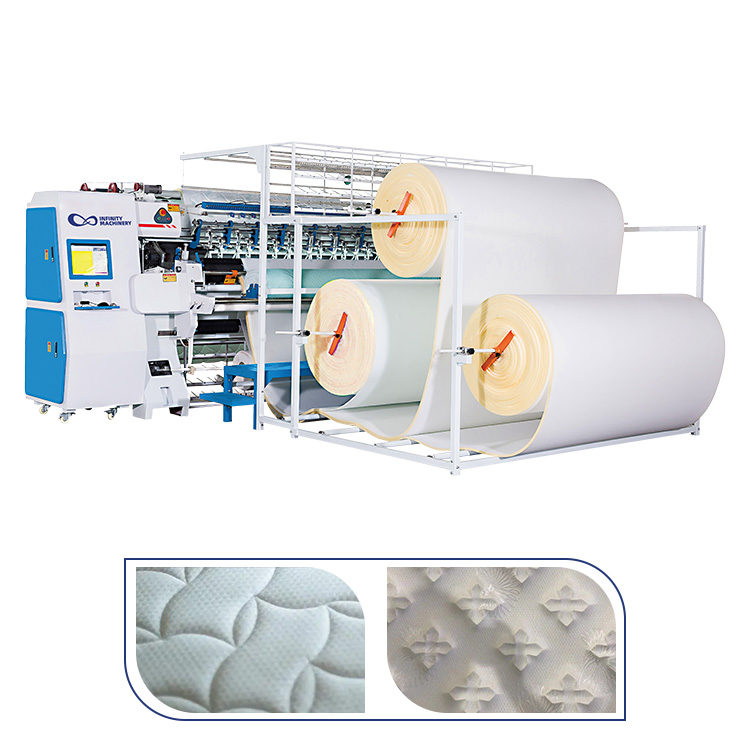
Here's what this guide covers: Your quilting station is probably the most expensive bottleneck on your production floor. It's not that the machine is slow — it's that most factories choose the wrong machine for their volume. We break down the IF-Q-1400 multi-needle chain stitch and IF-QS2-1 single needle computerized quilting machines, show real production data from factories using each, and give you a framework to decide which one doubles your throughput.
Every mattress factory has one: the station where the quilted fabric runs through the machine, and the rest of the production line waits for it. Quilting is inherently the slowest step in mattress manufacturing because each panel has to be fed, aligned, stitched, trimmed, and stacked — and the machine can only work as fast as the pattern complexity allows.
But here's what we've seen across 50+ mattress factories: the bottleneck isn't usually the machine's rated speed. It's a mismatch between the machine type and the production volume. Factories running 200+ mattresses per day on a single-needle quilting machine are leaving 40–60% of their quilting capacity on the table. Factories running 50 mattresses per day on a multi-needle industrial machine are burning capital they didn't need to spend.
We visited a mattress factory in Colombia last year. They had two single-needle quilting machines running 20 hours per day, producing quilted fabric for 180 mattresses. The operator turnover was high — the job was repetitive and exhausting. The quilting station was producing defects on 6% of panels because the operators lost focus after hour 12 of a shift. The factory owner thought the solution was to hire more operators.
The real solution was to replace one single-needle machine with a multi-needle IF-Q-1400. One machine, one operator, one shift. Output went from 180 to 220 mattresses per day. Defect rate dropped from 6% to 0.8%. The machine paid for itself in 4 months. The owner told us: "I was managing around the bottleneck instead of removing it."
The key insight: quilting bottlenecks aren't always solved by adding more machines. Often they're solved by choosing the right machine architecture for your volume. Let's look at the two options.
The IF-Q-1400 is a multi-needle chain stitch quilting machine designed for factories that need high-volume, consistent quilting output. It uses multiple needles running simultaneously to stitch the entire width of the mattress panel in a single pass. Where a single-needle machine has to move the needle back and forth across the panel (creating a serpentine path), the multi-needle machine quilts the full width at once.
How much difference does this make? In real terms: a single-needle quilting machine producing a standard queen-size quilted panel takes approximately 3–4 minutes per panel. The IF-Q-1400 takes 45–60 seconds. That's a 4x speed improvement on the quilting step alone.
But speed isn't the only advantage. The multi-needle design means the stitching tension is consistent across the entire width because all needles are fed from the same thread path. With a single-needle machine, the stitch tension varies across the panel because the thread has to travel from the needle to the edge — longer distance = more tension variation. This is why multi-needle quilting produces a flatter, more professional-looking panel.
What the IF-Q-1400 brings to your factory:
The IF-Q-1400 is the right choice when your daily production exceeds 100 mattress sets and your quilting station is consistently the bottleneck. It's also the right choice when you need consistent stitch quality across long production runs — the multi-needle system delivers identical tension panel after panel.
The IF-QS2-1 is a single-needle quilting machine, but it's not your grandfather's single-needle machine. It's a fully computerized, servo-driven system designed for factories that need pattern flexibility over raw speed — the ability to run short production runs, complex patterns, or frequent design changes without losing efficiency.
Where the multi-needle machine excels at speed, the single-needle excels at precision and versatility. The IF-QS2-1 can sew intricate embroidery-style patterns, curved stitching lines, and custom designs that a multi-needle machine cannot reproduce because the multi-needle design is limited to straight-line or simple-wave patterns across the panel width.
The IF-QS2-1 also features automatic fabric feeding and edge trimming, which means the operator places the fabric at the feed point, and the machine handles the rest — feeding, stitching pattern, and trimming the edges to the correct width. This reduces the operator's role from "guiding the fabric through the machine" to "loading and unloading," which dramatically reduces training time and error rates.
Specifications that matter for the IF-QS2-1:
A bedding factory in Egypt that produces decorative mattress toppers and cushions found their niche with the IF-QS2-1. They run 30–40 different patterns per week, with batch sizes as small as 10 pieces. A multi-needle machine would have required a minimum run length per pattern that made short runs uneconomical. The IF-QS2-1's ability to switch patterns instantly with zero setup time made short-run quilting profitable for them. They now run a 2-shift operation with one machine producing 280 finished panels per day.
The IF-QS2-1 is the right choice when your production involves multiple patterns, custom designs, or frequent style changes. It's also the right choice for factories producing under 100 mattress sets per day, where the speed advantage of the multi-needle machine would be underutilized.
Some factories don't have to choose between speed and flexibility. The IF-Q-1200 is a computerized chain stitch multi-functional quilting machine that bridges the gap between the single-needle precision of the IF-QS2-1 and the raw speed of the IF-Q-1400.
The IF-Q-1200 is a multi-needle machine (like the IF-Q-1400) but it's designed for a wider range of applications — not just mattress panels, but also household ornaments, carpet cushions, and upholstery components. It runs at high speed with low vibration, uses computerized pattern control, and can be switched between product types faster than the IF-Q-1400 because of its more flexible material handling system.
The IF-Q-1200 is the recommended option for factories that produce a mix of mattress types (different sizes, different patterns) alongside other quilted products. It gives you the multi-needle speed advantage while maintaining the pattern flexibility that the pure high-volume machine sacrifices.
A mattress factory in South Africa runs the IF-Q-1200 as their primary production machine and keeps an IF-QS2-1 for custom orders and short runs. This two-machine configuration gives them the ability to run 200 standard mattresses per day on the IF-Q-1200 while using the IF-QS2-1 for the 10–15 custom pieces that come through each week. Total investment for both machines is less than what they would have spent on a single industrial quilting system from a European manufacturer — with comparable output.
Here's a practical guide to choosing between the three machines based on your production profile:
| Your Profile | Best Machine | Panel Time | Est. Investment |
|---|---|---|---|
| Under 50 mattress sets/day, custom patterns, high variety | IF-QS2-1 | 3–4 min | $ |
| 100+ mattress sets/day, standard patterns, high volume | IF-Q-1400 | 45–60 sec | $$ |
| Mixed production: mattresses + cushions + ornaments | IF-Q-1200 | 1–2 min | $$ |
| High volume (200+) + custom runs (10–15/day) | IF-Q-1200 + IF-QS2-1 | Mixed | $$$ |
Before you decide on a machine, run this quick audit on your current quilting station:
Most factories find at least three items on this list that need attention. Fixing the machine mismatch (choosing single vs multi-needle based on volume) usually solves all of them simultaneously.
Send us your current production volume, pattern count, and defect rate. We'll send back a 2-page quilting station analysis with machine recommendation and ROI estimate — free, 24-hour turnaround.