You've got a foaming line that runs 24/7. Blocks come out, they go to cutting, and you think everything is fine. But it's not. I've walked through 40+ foam factories across Asia and Latin America, and I keep seeing the same bottleneck: the vertical cutting stage. Most factories are using outdated equipment that wastes material, slows down production, and bleeds money in ways they don't even notice. One factory in Colombia was losing $20,000 a year just from inaccurate vertical cuts — and they had no idea until they measured it. Here's how it happens, and how they fixed it.
When you cut a foam block vertically — slicing it into sheets for mattresses, cushions, or packaging — every millimeter of error multiplies across every sheet in the block. If your blade wanders by just 1mm over the height of a 1000mm block, and you're cutting 2,000 blocks a month, that's 2,000 linear meters of wasted material per month. At foam prices of $3-$8 per kg, that waste adds up fast.
Most factories don't measure this waste. They blame inconsistencies on the foam itself, on density variations, on bad raw material. But 9 times out of 10, the problem is the cutting machine — poor blade tension, inaccurate guides, outdated drive systems.
A mattress factory in Colombia — 200 employees, producing 15,000 mattresses a year — called us frustrated. Their reject rate from cutting was running at 8%. They thought it was operator error. We walked through their cutting line and found the real culprit: their vertical cutting machine was so worn that the blade drifted up to 3mm over the cutting height. They didn't notice because the drift was gradual — but it was costing them over $20,000 a year in scrap.
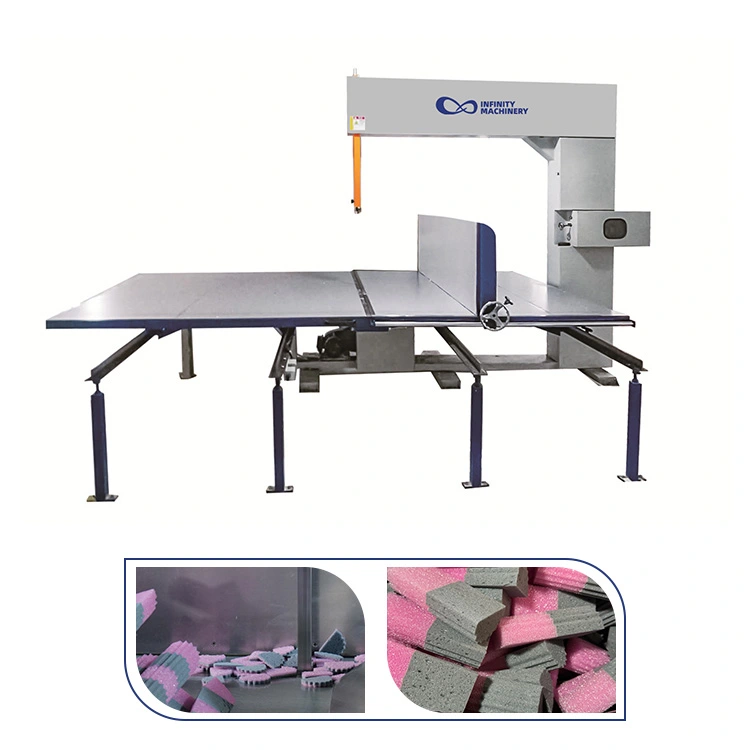
They replaced their aging vertical cutter with an IF-FZQ3 Vertical Foam Cutting Machine. The difference was immediate. The IF-FZQ3 uses a touch screen PLC control system with multi-thickness presets — the operator sets the thickness once, and the machine repeats it within ±0.1mm across the full cutting height. No drift. No guesswork.
Key specs that mattered to them:
The factory manager told us after the first month: "We cut 1,800 blocks in week one. Not one rejection for dimensional error. Our old machine would have given us at least 40 rejects in that volume. The IF-FZQ3 paid for part of itself in the first month alone."
A good vertical cutter gets you precise sheets. But what happens when you need to cut those sheets into specific profiles — mattress corners, contour shapes, custom foam inserts? That's where profile cutting comes in. Many factories run vertical and profile cutting on separate machines, creating a handoff delay that eats up 15-20% of production time.
The IF-CNCV CNC Contour Sponge Cutting Machine solves this. It uses a servo-driven vertical blade with high-precision guide rails to cut complex shapes directly from foam sheets — no templates, no manual tracing. The Colombian factory added one after the IF-FZQ3 and eliminated their entire manual contour-cutting station (3 workers, now redeployed to other areas).
Here's what the Colombian factory's production data looked like 3 months after installing the IF-FZQ3 + IF-CNCV combo:
| Metric | Before | After |
|---|---|---|
| Cutting reject rate | 8% | 0.8% |
| Material waste per block | ~5% | ~0.5% |
| Profile cutting labor | 3 workers, full-time | 1 worker, part-time |
| Blade changes per week | 3-4 | 1 |
| Annualized savings | ~$28,000 |
Of course, none of this cutting matters if your upstream foaming isn't producing consistent blocks. The IF-FF4 Horizontal Continuous Foaming Plant is the foundation that the best-run factories build their cutting lines on. It produces continuous foam blocks with densities from 4 to 180 kg/m³ — consistent, predictable, ready to cut. When the IF-FF4 feeds an IF-FZQ3 vertical cutter and an IF-CNCV contour machine, you get a seamless foaming-to-cutting operation with minimal waste and maximum throughput.

Density range: 4–180 kg/m³ | Applications: Furniture, bedding, packaging, automotive, aviation
When paired with IF-FZQ3 and IF-CNCV, the IF-FF4 creates a complete foaming-to-cutting production line. Foam comes out of the continuous plant, moves to vertical slicing on the IF-FZQ3, then to contour cutting on the IF-CNCV. One flow, minimal handling, maximum yield.
Here's a quick self-check. If any of these sound familiar, your cutting line is costing you more than it should:
The Colombian factory had four out of five. After replacing their vertical cutter with the IF-FZQ3 and adding the IF-CNCV for contour work, they went from four problems to zero. The production manager told us something that stuck with me: "The foam didn't change. The operators didn't change. The only thing that changed was the machine. And it changed everything."
Tell us your monthly block volume and current reject rate. We'll calculate your annual waste cost and show you the ROI on a cutting line upgrade. Free, no obligation.