
Foam scrap is not waste. It is the raw material for a profitable product: rebonded foam. The IF-FZS1/2 Re-Bonding Foam Machine takes crushed foam crumb from your cutting operations, mixes it with a one-component PU adhesive binder, and compresses it into dense blocks. These rebonded blocks sell for $200-400 per cubic meter, turning your scrap into a steady revenue stream.
A packaging manufacturer in Malaysia was landfilling 12 tons of foam scrap each month at a cost of $1,500. They added an IF-FZS1 rebonding line to process the scrap into packaging blocks. The rebonded foam sold for $240/m3, generating $7,200/month in new revenue. The machine paid for itself in 3 months, and the landfill cost disappeared.
Rebonded foam (also called reconstituted or rebond foam) is made by taking crushed polyurethane foam particles, coating them with a flexible adhesive binder, and compressing the mixture under high pressure. The result is a dense, resilient foam block with excellent vibration dampening, sound absorption, and impact resistance properties.
Rebonded foam is widely used in packaging, flooring underlayment (carpet padding), sports mats, playground surfaces, and industrial applications. The density can be controlled from 30 kg/m3 to 150 kg/m3 by adjusting the compression ratio and binder content, making it versatile across many markets.
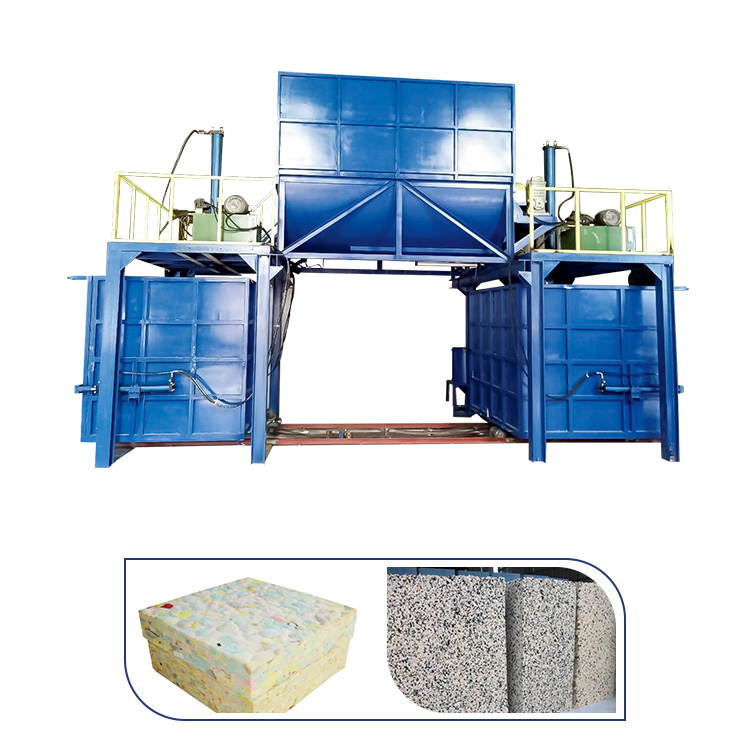
Rebond foam scrap into dense blocks. 100-300 kg/batch. Densities 30-150 kg/m3. Two models for different output volumes.
View Product →The IF-FZS1/2 rebonding machine follows a simple, efficient process:
Step 1 - Crumb feeding: Foam crumb from the IF-FFS3 crushing machine (or pre-crushed scrap) is loaded into the mixing chamber. The crumb should be 5-30mm in diameter for optimal results.
Step 2 - Binder spraying: The machine sprays a measured amount of one-component PU adhesive binder onto the crumb while rotating the mixing drum. The binder coats each particle evenly. Typical binder content is 8-15% by weight.
Step 3 - Compression: The coated crumb is transferred to the compression mold. A hydraulic press applies controlled pressure to compress the mixture into a block. Pressure and compression time determine the final density.
Step 4 - Curing: The compressed block is held under pressure until the binder cures. Curing time is typically 15-30 minutes depending on binder formulation and ambient temperature. After curing, the block is ready for demolding and final cutting.
| Specification | IF-FZS1 | IF-FZS2 |
|---|---|---|
| Batch Size | 100-150 kg | 200-300 kg |
| Density Range | 30-150 kg/m3 | |
| Block Size | L2000 x W1000 x H1000 mm | L2000 x W1500 x H1000 mm |
| Cycle Time | 20-30 min | 25-35 min |
| Daily Output | 15-20 blocks | 20-30 blocks |
| Total Power | 15 kW | 22 kW |
| Metric | Value |
|---|---|
| Investment (IF-FZS1) | $12,000-18,000 |
| Monthly output (8h/day) | 300-400 blocks (approx. 30 m3) |
| Revenue at $240/m3 | $7,200/mo |
| Raw material cost (scrap + binder) | ~$1,500/mo |
| Net monthly profit | $5,700/mo |
Payback period: 3-4 months. After payback, the IF-FZS1 generates $5,000+ per month in profit while eliminating foam waste disposal costs.
Build a complete foam recycling line with these complementary machines:
Tell us your monthly scrap volume, current disposal costs, and target rebonded foam density. We will recommend the right IF-FZS model.
