Your foam blocks come out of the mold. They look fine. Solid. Even. You weigh them, you measure them, they pass inspection. But when your cutting team starts slicing them into sheets, something's off. Some sheets are too soft. Some are too firm. Your reject rate climbs. Your customers complain about inconsistent feel. And you're losing 10-15% of every batch to scrap you can't explain. A mattress factory in Thailand — 300 mattresses a day — had this exact problem. They blamed the raw chemicals. They blamed the operators. But the real problem was hiding in plain sight: their foaming line couldn't hold consistent density, and their cutter amplified every variation. Here's how they fixed both.
Here's what happens in most foam factories. You start a batch. The first few meters come out perfect — the right density, good cell structure, consistent feel. But as the batch runs, things change. Temperature in the mixing head drifts. Chemical feed rates fluctuate. The conveyor speed isn't perfectly synchronized with the pour. By the time you're 10 meters into the block, the density has shifted by 5-10%. By the end of the block, it can be off by 15% or more.
You can't see it. The block looks the same from the outside. But when you cut it, every sheet has a different feel. Your mattress production team starts fighting with the foam — too soft on one end, too firm on the other. They reject sheets. They adjust their process. They blame each other.
A mattress factory in Thailand — let's call them Thai Bedding Co. — was pulling their hair out over this. They were producing 300 mattresses a day, mostly for hotel chains. Their reject rate from foam inconsistency was running at 12%. The hotel chains were starting to complain. One major client threatened to switch suppliers. The production manager spent weeks chasing the problem: different chemical suppliers, different operator shifts, different curing times. Nothing worked. The density drift was baked into their foaming process.
Thai Bedding was running an old manual foaming setup — the kind where operators adjust chemical ratios by hand and the conveyor speed is set with a dial. It worked fine in the 1990s. But modern mattress buyers expect consistent feel across every mattress, every batch, every shipment. Hand-adjusted foaming can't deliver that.
They replaced their old setup with the IF-FF4 Horizontal Continuous Foaming Plant. The IF-FF4 uses a continuous pour system with digital control over every variable: chemical flow rates, mixing speed, conveyor speed, temperature. Instead of relying on operator judgment, the machine maintains the same settings throughout the entire run. The result? Density stays within ±2% from the first meter to the last. No drift. No surprise. Every block comes out the same.
Here's what the IF-FF4 controls that fixes density drift:
The IF-FF4 covers a density range of 4 to 180 kg/m³ — from ultra-soft memory foam to high-density packaging foam. Thai Bedding runs theirs at 25-45 kg/m³ for mattress production, and it holds density within ±1.5% across 20-meter continuous blocks. Their old system fluctuated by ±8% on a good day.
Here's the part most factories miss. Even with perfect density from the foaming line, a bad cutting machine can undo all that work in one pass. If the blade drifts, if the tension is inconsistent, if the guide rails are worn, you'll get sheets that vary in thickness. And thickness variation = density variation in the final product.
Thai Bedding's old vertical cutter had a blade drift of up to 2mm over the cutting height. That meant a sheet specified at 50mm could come out at 48mm on one end and 52mm on the other. In a 200-sheet block, that's a lot of out-of-spec foam. They were throwing away or downgrading about 8% of their cut sheets just from cutting inaccuracy alone — on top of the density variation from their foaming line.
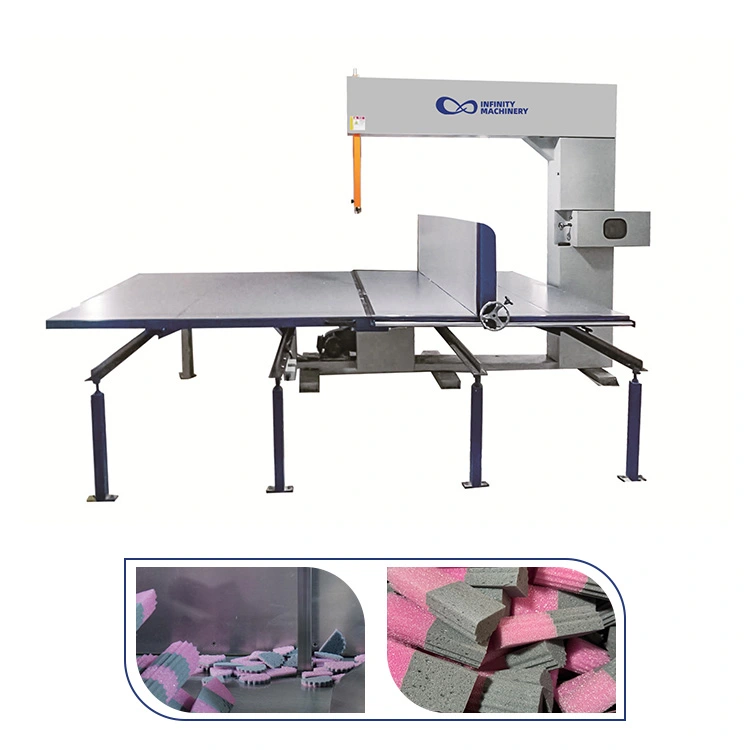
They replaced their old cutter with the IF-FZQ3 Vertical Foam Cutting Machine. The IF-FZQ3 uses a PLC touchscreen control system with servo-driven blade carriage and precision guide rails. The operator sets the cutting thickness once. The machine repeats it within ±0.1mm across the full 1100mm cutting height. No drift. No variance. Every sheet, exactly the same thickness.
Key specs that mattered to Thai Bedding:
The production manager told us: "I spent 8 months chasing a chemical problem. Turned out the foam was fine. The cutter was the problem. The IF-FZQ3 showed us exactly where our waste was coming from — the blade drift was literally cutting money off every sheet."
Thai Bedding tracked their numbers for 3 months after installing both the IF-FF4 and IF-FZQ3. Here's what they found:
| Metric | Before (Old Setup) | After (IF-FF4 + IF-FZQ3) |
|---|---|---|
| Density variation across block | ±8% | ±1.5% |
| Cutting thickness tolerance | ±2mm | ±0.1mm |
| Cutting reject rate | 8% | 0.7% |
| Total foam utilization | ~72% | ~94% |
| Customer returns (per month) | 15-20 | 2-3 |
| Foam waste per month (tons) | ~4.5 tons | ~1 ton |
| Annual foam material savings | $0 | ~$38,000 |
| Total annual savings | ~$52,000 (material + labor + returns) |
Equipment investment: IF-FF4 ($48,000) + IF-FZQ3 ($5,800) = $53,800
Payback period: $53,800 ÷ $52,000 = 12.4 months
And that doesn't count the hotel chain contracts Thai Bedding retained because their consistency improved. Their largest client — a 40-hotel group — was about to leave. After the IF-FF4 and IF-FZQ3, the hotel's quality team audited the factory and approved them for another 3-year contract. That contract alone is worth $240,000 in annual revenue.
Once Thai Bedding had consistent density from the IF-FF4 and precise sheets from the IF-FZQ3, they started thinking about volume. Their old carrousel splitting machine (the one that cuts multiple blocks at once) was slow and prone to vibration that knocked the blade out of alignment. On high-volume days, they were bottlenecking at the splitting stage — blocks piling up, waiting to be cut.
The IF-FYP6/7/10 Carrousel Splitting Foam Cutting Machine solved this. It's a fully automatic digital-controlled carrousel that holds multiple foam blocks simultaneously — up to 4 on the IF-FYP6, 5 on the IF-FYP7, and 8 on the IF-FYP10. The operator sets the cutting thickness on the control box and the machine runs. Inverter speed control on the table rotation gives smooth, vibration-free cutting at up to 3.5 r/min. Cutting accuracy stays at ±0.1mm, matching the IF-FZQ3. The optional vacuum table holds blocks firmly in place, eliminating movement during the cut.
Thai Bedding added the IF-FYP7 (7-meter diameter, 5 blocks per cycle) six months after the IF-FF4 and IF-FZQ3. It doubled their splitting capacity without adding operators. The factory went from 300 to 480 mattresses per day over the next 3 months — all with consistent density and precise dimensions.

Diameter: 6/7/10.5m | Block capacity: 4/5/8 pcs | Precision: ±0.1mm | Speed: Up to 3.5 r/min
High-volume carrousel splitting machine for factories that need to process multiple blocks simultaneously. Fully automatic digital control with inverter speed control and optional vacuum table. Cuts foam thickness from 2-150mm. When paired with the IF-FF4 foaming line and IF-FZQ3 vertical cutter, creates a complete quality-controlled production chain from raw chemicals to finished sheets. Thai Bedding doubled their daily output after adding this machine.
Here's a quick self-check. If any of these sound familiar, density inconsistency is eating your profit:
Thai Bedding had all five. After the IF-FF4 and IF-FZQ3, they went from five problems to zero. The owner told us: "The chemicals were fine. The operators were fine. It was the equipment. I spent $53,800 and saved $52,000 a year — plus I kept a $240,000 contract I was about to lose. That's not an expense. That's the best investment I've made in 10 years."
Here's what every foam factory should take away from Thai Bedding's story:
If you're not sure whether density inconsistency is hitting your bottom line, we can help you measure it. The IF-FF3 Automatic Box Foaming Machine is a lower-volume alternative to the IF-FF4 — same digital density control, smaller footprint, ideal for factories producing under 1,000 blocks per month. If the IF-FF4 is too much machine for your current volume, the IF-FF3 gets you the same density consistency at a lower entry price.
Send us your monthly foam volume, current reject rate, and chemical usage. We'll calculate your hidden density waste and show you the ROI on an IF-FF4 + IF-FZQ3 upgrade. Free, no obligation, 48-hour turnaround.