
You produce foam rolls — sheets of peeled foam, quilted foam rolls, or foam laminate rolls. They come off the production line at full volume: light, fluffy, and taking up enormous amounts of space. Every square meter of your warehouse is filled with foam rolls that are mostly air. And when you ship them, you are paying freight costs for that air.
A mattress factory in Egypt was spending $4,800 per month on warehousing for foam rolls alone and another $2,200 per month on freight. They added an IF-FCR3 Roll Foam Compressing Machine and compressed every roll before storage or shipping. Their warehousing cost dropped to $1,100/month, and their freight cost fell by 68%. The machine paid for itself in under 5 months.
A roll foam compressing machine takes loose, bulky foam rolls and compresses them into dense, banded bales. The compression ratio typically reaches 70-80%, meaning a roll that originally occupies 1 cubic meter is compressed to just 0.2-0.3 cubic meters. The compressed bale is then strapped or banded to maintain its compact shape during storage and transport.
The IF-FCR3 Roll Foam Compressing Machine is designed for continuous, high-volume operation in foam and mattress production facilities. It handles rolls up to 2150mm wide and can compress multiple rolls per hour, depending on operator speed and roll size.
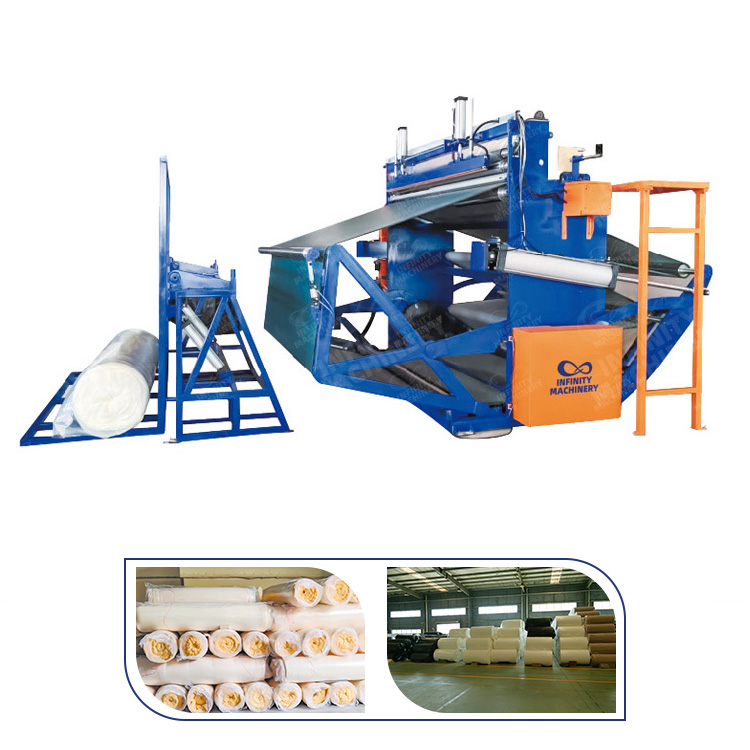
Compresses foam rolls into dense bales at 70-80% volume reduction. Automatic banding. Handles rolls up to 2150mm wide.
View Product →| Cost Factor | Without IF-FCR3 | With IF-FCR3 | Annual Savings |
|---|---|---|---|
| Warehouse space (200 rolls/month) | $12,000/yr | $3,600/yr | $8,400 |
| Freight (40 containers/yr) | $32,000/yr | $10,800/yr | $21,200 |
| Packaging materials | $5,400/yr | $2,700/yr | $2,700 |
| Total annual cost | $49,400/yr | $17,100/yr | $32,300/yr |
With an estimated equipment investment of $12,000-$18,000 for the IF-FCR3, the typical payback period is 4 to 7 months. After payback, every year of operation generates over $30,000 in direct savings.
The IF-FCR3 works seamlessly with other foam processing machines. Consider adding it to a line that includes the IF-FYQ1 Foam Peeling Machine for a complete peeling-to-compression workflow, or pair it with the IF-FZS1/2 Re-Bonding Machine to handle compressed scrap foam.
Before the IF-FCR3, factories had limited options for compressing foam rolls. Some used manual methods: stacking heavy weights on rolls or wrapping them tightly with straps. These approaches were inconsistent, labor-intensive, and rarely achieved more than 30-40% volume reduction.
Industrial balers designed for cardboard or plastic were sometimes adapted for foam, but they lacked the controlled pressure settings needed for different foam densities and could damage soft foam. The IF-FCR3 is purpose-built for foam — with adjustable compression pressure that adapts to foam density from 8-80 kg/m³.
A factory in Saudi Arabia was using a manual strap-compression method that took 15 minutes per roll and achieved only 35% volume reduction. After switching to the IF-FCR3, their cycle time dropped to 3 minutes per bale and compression increased to 75%. The labor savings alone paid for the machine in 8 months.
Q: "Does compression damage the foam?"
A: No. Polyurethane foam is elastic and recovers its original shape after compression. The IF-FCR3 applies controlled, even pressure that does not permanently alter the foam cell structure. Tests show that compressed foam returns to 98-100% of its original thickness within 24 hours of being unpacked.
Q: "How long can foam stay compressed?"
A: Foam can stay compressed indefinitely without damage, as long as it is stored in a dry, temperature-controlled environment. We have customers who store compressed foam bales for 6-12 months before use with no quality issues.
Q: "What is the maximum roll width the IF-FCR3 can handle?"
A: The IF-FCR3 handles rolls up to 2150mm wide, which covers the standard widths from most foam peeling and quilting machines.
Q: "Can the IF-FCR3 handle different foam densities?"
A: Yes. The machine has adjustable compression pressure settings that you can dial in for different foam densities, from soft polyurethane (8 kg/m³) to firm rebond foam (80 kg/m³+).
Tell us your roll volume, sizes, and current logistics costs. We will show you exactly how much the IF-FCR3 can save your factory.
