You're running a foam production line. Every day you generate scrap — edge trimmings, offcuts, blocks that didn't come out right, rejects from quality control. What do you do with it? If you're like most factories, you either throw it away or sell it to a recycler for pennies. One mattress factory in Vietnam was throwing away about $5,000 worth of foam scrap every month. Not anymore. Here's exactly how they turned that cost into a profit center — and how the numbers worked out.
Every foam factory has waste. It's built into the process. Trimming blocks to size, shaping profiles, cutting contours — every operation produces scrap. Some factories lose 5-8% of their raw material to waste. On a production line running 50 tons of foam per month, that's 2.5 to 4 tons of scrap. Gone.
Most factories sell this scrap to third-party recyclers for a fraction of its value — if they can find a buyer at all. Others simply pay to have it hauled away. Either way, it's a cost, not a revenue stream.
But here's what successful factories have figured out: foam scrap isn't waste — it's raw material for a completely different product line. Rebond foam (also called reconstituted foam or bonded foam) is made by shredding scrap foam, mixing it with adhesive, and compressing it into blocks. The result? A dense, high-strength foam that sells for $3-$6 per kg depending on density — often higher margin than your primary foam products.
A mattress factory in Vietnam — let's call them Binh Duong Mattress Co. — runs two shift lines producing polyurethane foam for mattresses and furniture. Standard stuff. Every month they were generating about 3.5 tons of scrap foam. They were paying a local recycler to take it away. Total loss: about $5,000/month in raw material plus disposal fees.
Their production manager had heard about rebond foam but assumed the equipment was too expensive and complicated. When he finally ran the numbers, he realized the payback was faster than almost any other equipment investment they could make.
Here's what they bought:
They started with two machines working together as a mini production line:
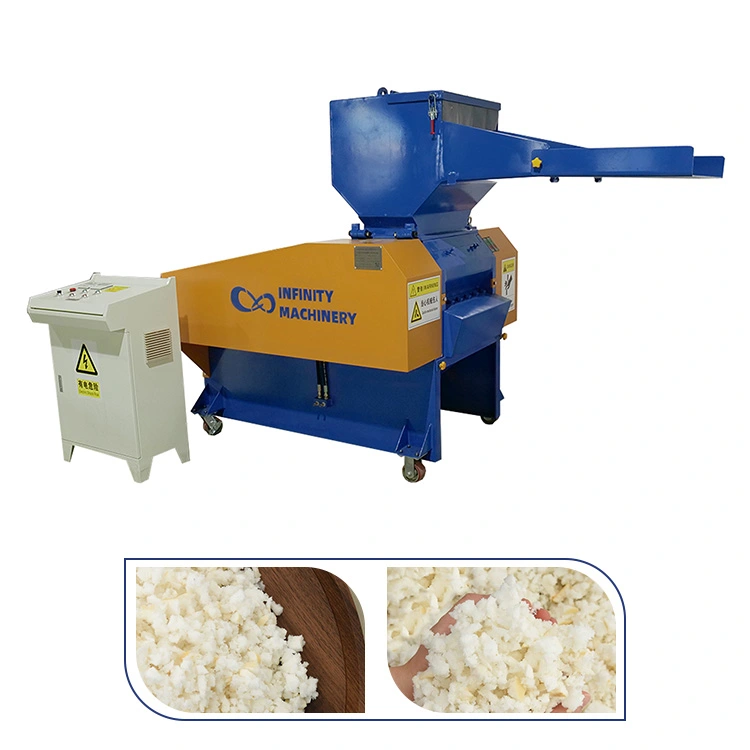
Step 1: Crushing — IF-FFS3 Crushing Foam Machine
The IF-FFS3 Crushing Foam Machine takes scrap foam, cloth waste, and trimmings and shreds them into uniform granules. It uses 4 stationary cutters and 3 rotary cutters working together — the stationary blades provide initial breakdown while the rotary blades pulverize the material to a consistent particle size. This uniformity is critical because uneven particles create weak spots in the final rebond block. The machine handles everything: soft polyurethane foam, memory foam scraps, even fabric waste from quilting operations.
Step 2: Bonding + Pressing — IF-FZS1/2 Re-Bonding Foam Machine
Once the foam is crushed to granules, the IF-FZS1 Re-Bonding Foam Machine takes over. The granules are mixed with a specialized adhesive, loaded into a mold, and compressed under hydraulic pressure while steam is applied to cure the bond. The result is a solid block of rebond foam — dense, uniform, and ready for cutting. The steam activation is key: it ensures the adhesive penetrates every particle and creates a consistent bond throughout the block. Without steam, you get weak spots and delamination.
Here's the actual financial breakdown from Binh Duong's first 4 months of operation:
| Item | Before Rebond | After Rebond |
|---|---|---|
| Monthly scrap generated | 3.5 tons | 0.5 tons (only non-recyclable) |
| Scrap disposal cost | -$800/month (hauling fees) | -$0 |
| Raw material value of scrap | -$4,200 (wasted material) | $0 (reused in rebond) |
| Rebond foam output value | $0 | ~$12,500/month (sold at $4/kg) |
| Monthly impact | -$5,000 | +$12,500 (+$17,500 swing) |
Equipment cost: IF-FFS3 ($8,500) + IF-FZS1 ($11,200) + installation ($1,200) = $20,900 total
Monthly operating cost: adhesive ($1,800) + steam/energy ($600) + labor ($1,200) = $3,600
Net monthly profit from rebond: $12,500 - $3,600 = $8,900
Payback period: $20,900 ÷ $8,900 = 2.3 months
The production manager told us: "I was skeptical. I thought rebond equipment was complicated and expensive. But the IF-FFS3 and IF-FZS1 are simpler to operate than our main foaming line. Two of our existing workers trained on them in one shift. We broke even before the end of month 3."
If you're wondering "who buys rebond foam?" — the answer is more customers than you think. Rebond foam has distinct properties that make it preferable to virgin foam in many applications:
The Binh Duong factory sells 60% of their rebond output to carpet underlay buyers. The rest goes to furniture and packaging clients. They could sell more if they increased production — they're currently operating at 70% capacity with the IF-FFS3 and IF-FZS1.
The IF-FFS3 + IF-FZS1 combo is the most common starting point for rebond operations. But if you're running a high-volume foam plant and you want to integrate rebond production into your main line, there's a bigger picture to consider.
The IF-FF4 Horizontal Continuous Foaming Plant is our flagship foaming line — capable of producing continuous foam blocks with densities from 4 to 180 kg/m³ for furniture, bedding, packaging, automotive, and aerospace applications. If you don't have a primary foaming line yet, or you're looking to upgrade your existing production, the IF-FF4 is the machine that makes everything else possible. It feeds your cutting line, your contour machines, and — yes — your rebond operation, because the scrap it generates becomes raw material for the IF-FZS1.

Density range: 4–180 kg/m³ | Applications: Furniture, bedding, packaging, automotive, aviation
The complete foaming solution. Continuous block production with touchscreen control. When paired with the IF-FFS3 and IF-FZS1, you create a closed-loop system where virtually nothing goes to waste — your prime foam goes to products, and your scrap goes to rebond. Maximum material utilization.
If you generate more than 1 ton of foam scrap per month, the numbers almost certainly work. Here's a quick self-assessment:
The Binh Duong factory's production manager summed it up: "I wish we'd done this two years ago. We were literally throwing away $60,000 a year. Now that's $100,000+ in revenue. Same scrap, different machine."
Send us your monthly scrap volume and we'll give you a personalized ROI projection — equipment cost, payback period, and expected revenue. Free, no obligation.