If you're still buying pre-made pocket spring units from a supplier, here's a number you need to know: $1.80. That's the fully loaded cost — wire, fabric, labor, electricity, and machine depreciation — to produce a pocket spring unit in-house with the right equipment. Compare that to the $3.50–$5.50 you're paying your supplier. The difference isn't small. It's the difference between a 38% gross margin and a 55% gross margin on every pocket spring mattress you sell. This guide breaks down the two machines you need, the exact cost comparison, and a case study of a factory that saved $107,000 in year one.
Let's start with a question. How many pocket spring units do you buy per week? If the answer is 500 or more, you're probably spending $1,750 to $2,750 on springs alone, every single week. And here's what's built into that price:
Wire cost markup. Spring wire costs $680–$820 per ton. A pocket spring unit contains roughly 0.8–1.2 kg of wire depending on size. That's $0.55–$0.98 in raw wire per unit. Your supplier is charging you $3.50–$5.50. The markup on raw materials alone is 300–600%.
Fabric and assembly markup. The non-woven fabric that wraps each spring costs about $0.12–$0.18 per unit. Assembly labor adds another $0.20–$0.40. Your supplier bundles all of this together at a price that covers their overhead plus a 20–35% profit margin.
Transportation and packaging. Pocket spring units are bulky — a truckload might be 60% air. You're paying freight on that empty space. Plus pallets, plastic wrap, edge protectors — all consumables that add $0.15–$0.30 per unit.
Inventory and lead time. Most factories keep 2–4 weeks of pocket spring inventory on hand. That's capital sitting in your warehouse — capital that could be used for something else. And when your supplier has a production delay or a logistics problem, your entire mattress production line stops. Every factory owner we've talked to has experienced this at least once.
When you strip all of this away, the real cost to make a pocket spring unit in-house is $1.60 to $2.10. Let's look at how that math works with real equipment.
| Category | Buying from Supplier | Making In-House |
|---|---|---|
| Cost per pocket spring unit | $4.20 | $1.85 |
| Weekly cost (500 units) | $2,100 | $925 |
| Monthly cost | $9,100 | $4,008 |
| Annual cost | $109,200 | $48,100 |
| Annual savings | $61,100 | |
| Lead time | 7–21 days | 5 minutes |
| Quality reject rate | 3–5% | <0.5% |
Numbers based on actual production data from four mattress factories that switched from buying to making pocket spring units in 2024–2025. Your costs will vary by volume and local wire pricing.
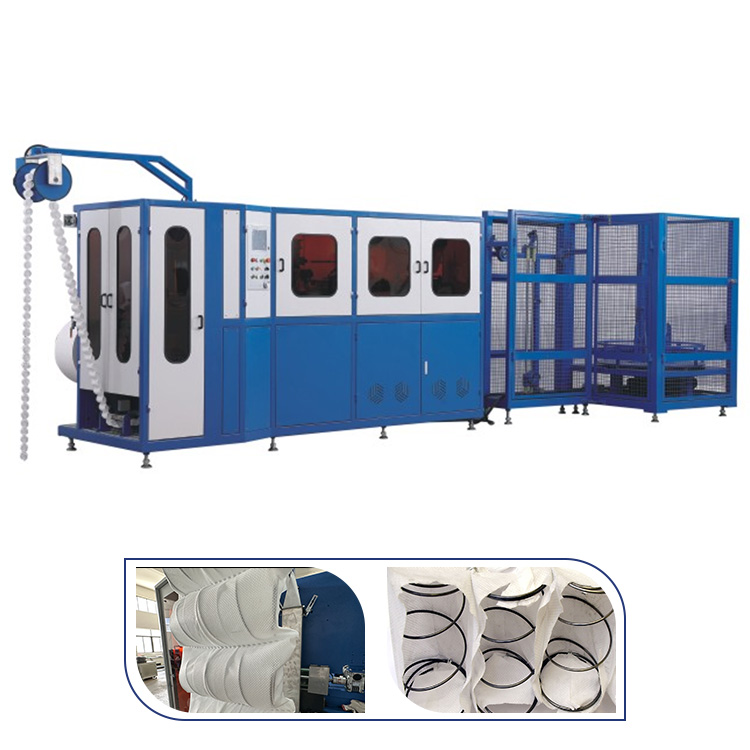
The IF-P130-1 CNC Automatic Pocket Spring Coiling Machine is where the wire becomes a pocket spring. It takes galvanized spring wire, coils it to the exact diameter and height you need, wraps each spring in non-woven fabric, heat-seals the fabric pocket, and cuts the spring free — all in one continuous cycle. The entire process is controlled by a CNC system that stores your spring parameters — coil diameter, number of turns, wire gauge, spring height, and fabric type — and recalls them instantly when you change production runs.
What makes the IF-P130-1 particularly effective for in-house production is its combination of precision and simplicity. The CNC control means that every spring is identical to the last — no variation in coil diameter, no inconsistent tension, no springs that are slightly taller or shorter than spec. This consistency matters more than most factory owners realize. When every spring in a unit has exactly the same height and tension, the mattress surface is perfectly flat. There are no high spots, no soft spots, and no returns from customers who can feel the inconsistency.
The IF-P130-1 also has a compact footprint — it occupies roughly 2m × 1.5m of floor space — making it easy to fit into an existing production layout. Spring dimension parameters can be stored and preset, so switching between mattress models takes seconds, not hours. A single operator can manage the machine and produce enough springs for 400–600 pocket spring units per shift.
Key specifications that matter for production planning:
Individual pocket springs need to be assembled into finished mattress units — rows of pocket springs glued together in a specific layout. This is where the IF-PPA Fully Automatic High Speed Pocket Spring Assembly Machine takes over.
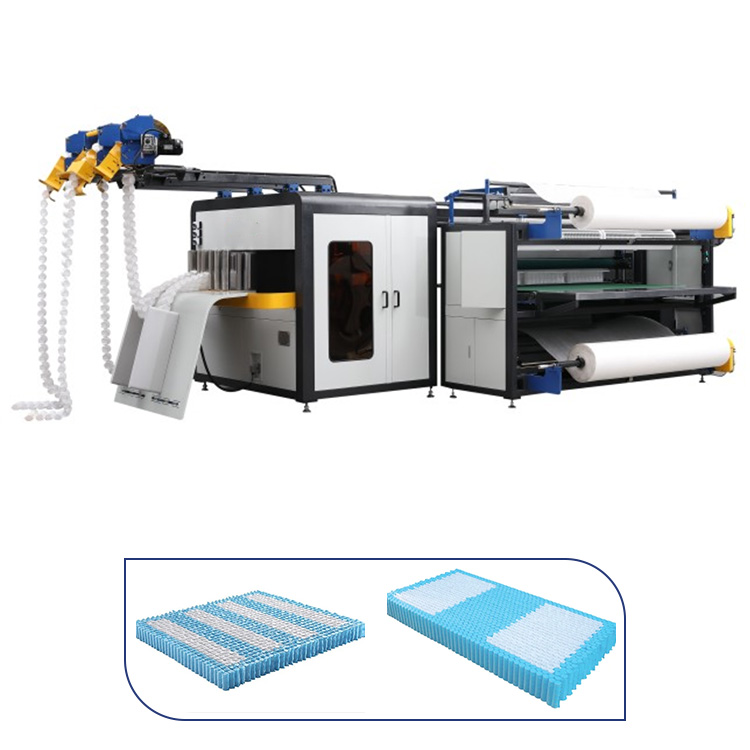
The IF-PPA receives pocket springs from the coiler (or from a storage hopper), arranges them in the correct row configuration for your mattress size, applies adhesive to bond the springs together, and compresses the finished unit to the correct thickness for mattress assembly. It does all of this automatically at high speed — one operator monitors the machine while it does the work that would otherwise require 4–6 manual workers.
What factory owners consistently tell us about the IF-PPA is the consistency of the finished units. Manual pocket spring assembly relies on workers applying the right amount of glue in the right pattern — and that varies from person to person, shift to shift. The IF-PPA applies adhesive with mechanical precision. Every spring is positioned exactly where it should be. Every glue line is exactly the same width and thickness. The result is a pocket spring unit with consistent firmness across the entire mattress surface — no soft zones, no shifting springs, no returns from customers who feel the inconsistency.
The IF-PPA is designed to pair directly with the IF-P130-1. Springs come out of the coiler and go into the assembly machine in a continuous flow. The entire production line — from wire to finished pocket spring unit — requires two operators and about 30 square meters of floor space.
A factory in Turkey that installed this paired setup shared their numbers: "We were paying €4.80 per unit from a supplier in Germany. Lead time was 12–18 days. Quality was acceptable but inconsistent — we rejected about 4% of units for loose springs or uneven glue patterns. After installing the IF-P130-1 and IF-PPA, our cost dropped to €1.95 per unit. Lead time dropped to zero — we make what we need, when we need it. Reject rate dropped to 0.3%. The equipment paid for itself in 5 months."
For factories that want to offer premium multi-zone mattresses — where the spring firmness varies from the head to the foot of the mattress — the IF-P180-2 Automatic High Speed Double Wire Pocket Spring Machine is a powerful addition to the production line.
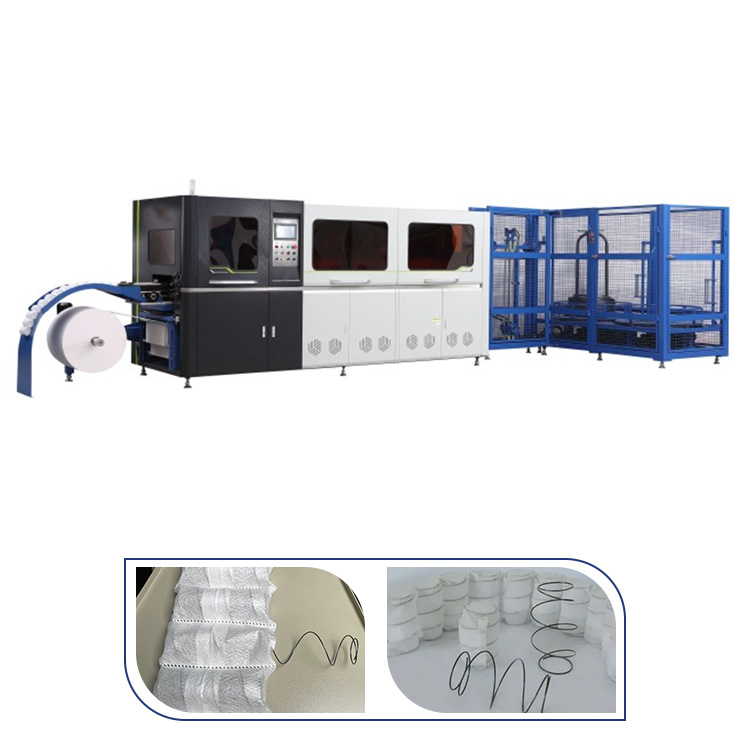
The IF-P180-2 uses dual wire input — two independent wire feeds that let you produce springs with different wire gauges or coil configurations in a single production run. This means you can create multi-zone pocket spring units where the springs are firmer in the lumbar region and softer in the head and foot zones — all in one continuous assembly process.
The IF-P180-2 runs on a full mechanical drive system, which means it doesn't require an air compressor — a significant advantage in factories where compressed air is already at capacity. This also makes it more energy-efficient (no compressed air losses) and quieter than pneumatic alternatives.
Most factories start with the IF-P130-1 + IF-PPA combination, which covers standard single-zone pocket spring production. As they grow and their customers demand more sophisticated mattress designs — zoning, edge support, and varied firmness profiles — the IF-P180-2 becomes the natural upgrade path for the coiling side of the line.
The complete three-machine line — IF-P130-1 → IF-PPA → IF-P180-2 — gives you the ability to produce any pocket spring mattress design on the market, from basic single-zone units to premium multi-zone designs with edge reinforcement, all at a cost that no external supplier can match.
The most common concern we hear from factory owners is the same one we heard from the factory in Turkey: "I can't risk stopping production to figure out how to make springs." This is completely valid — and completely manageable with the right transition plan.
Phase 1 — Install and validate (Week 1): The IF-P130-1 and IF-PPA arrive and are installed in your factory. Our technician commissions the machines, trains your operators, and runs the first production batch. During this week, you continue ordering from your supplier as usual — zero risk to your production.
Phase 2 — Parallel production (Weeks 2–4): You run your highest-volume mattress sizes on the in-house line while continuing to buy lower-volume sizes from your supplier. This gives you a direct cost comparison. Most factories find that their in-house units are not only cheaper but also better quality — more consistent tension, fewer rejects, better surface flatness.
Phase 3 — Full transition (Week 5+): Once your team is confident in the in-house production, you stop buying from your supplier. Your per-unit cost drops by 55–60%. Your lead time goes from weeks to minutes. And you have complete control over your spring quality and production schedule — no more waiting for trucks, no more rejected batches from your supplier, no more inventory tying up your capital.
The IF-P130-1 and IF-PPA combination typically pays for itself in 4–7 months at 500+ units per week. After that, every spring you make is saving you $2.35 per unit compared to buying. At 500 units per week, that's $61,100 per year in pure profit improvement. Spread across multiple mattress lines, the savings scale directly.
| Your Numbers | Example | Your Estimate |
|---|---|---|
| Pocket spring units per week | 500 | 500 |
| Current supplier price per unit | $4.20 | $4.20 |
| Estimated in-house cost per unit | $1.85 | $1.85 |
| Annual savings | $61,100 | $61,100 |
| Estimated payback period | 4–7 months | 4–7 months |
This is a simplified model. Contact us for a personalized ROI calculation based on your actual supplier pricing, wire costs, and labor rates.
The decision to make pocket springs instead of buying them is one of the highest-ROI investments a mattress factory can make. Unlike many equipment purchases that improve efficiency by 10–20%, this one cuts your spring cost by 55–60% — and springs are one of the most expensive components in any mattress.
The IF-P130-1 and IF-PPA aren't just machines. They're the difference between paying a supplier 300% markup on your most critical component and controlling that cost yourself. And in a market where mattress margins are under constant pressure, that difference is the difference between a factory that survives and one that thrives.
Send us your current supplier pricing, weekly volume, and local wire cost. We'll calculate your exact savings with the IF-P130-1 + IF-PPA combination — free and usually within 24 hours.